| Good morning everyone — we're sorry to report that we jinxed the warm weather by putting away our gloves on Friday. 🥶 Today's edition: Growth in national health spending slowed down after a steep rise at the outset of the pandemic. The White House will push efforts to improve air filters in schools and business in the latest strategy to thwart covid-19. But first … | Biden focuses on pandemic prep, mental health and medical breakthroughs in his budget request | 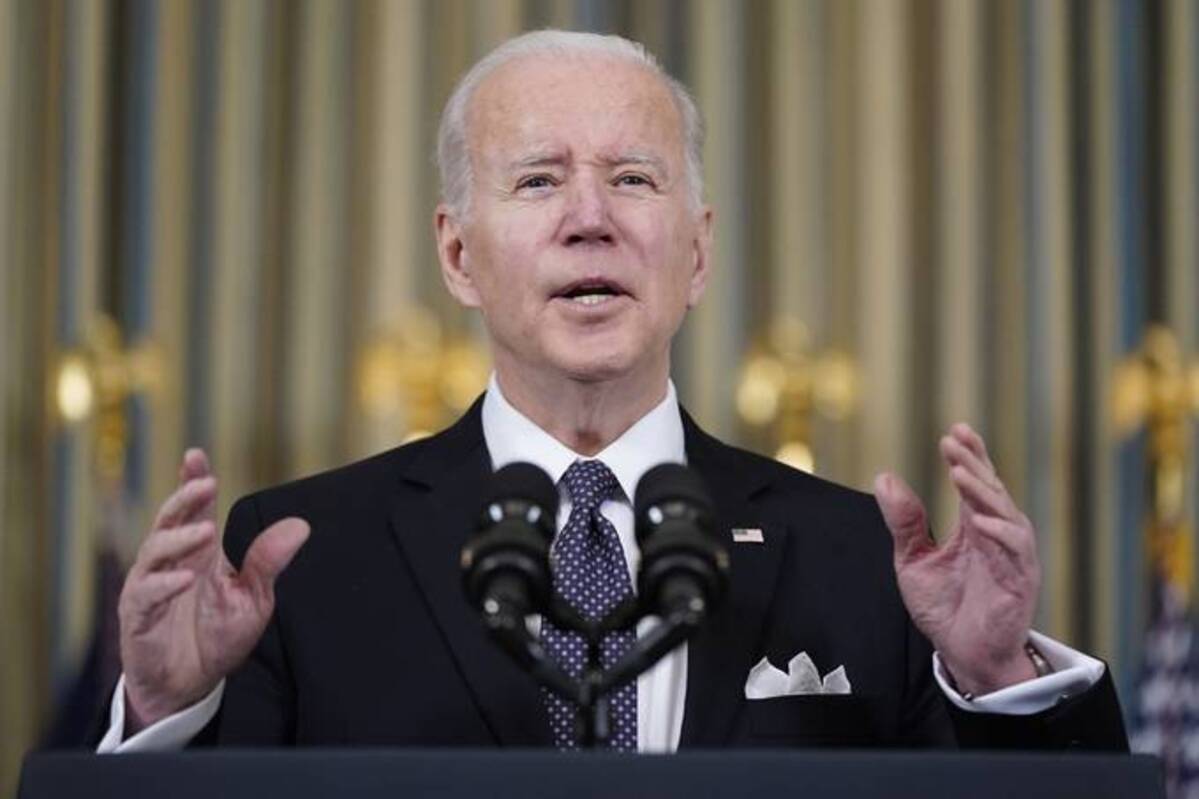 President Joe Biden speaks about his proposed budget for fiscal year 2023 on Monday. (AP Photo/Patrick Semansky) | | | What we learned from Budget Day™: President Biden wants nearly $82 billion over five years to help key federal agencies prep for pandemics and other biological threats. His administration is also leaning in on bipartisan measures, such as boosting coverage for mental health and more cash for a new agency to tackle some of the nation's biggest biomedical challenges. In one sense, the president's budget isn't a particularly useful document. Congress holds the power of the purse, and often ignores broad swaths of the president's requests. But on the other hand, the budget is a statement of the administration's priorities. And it's worth looking closely at the policies the White House deems most critical — and what it may lobby lawmakers for on Capitol Hill. | - "It's important in that respect, even if the document itself goes nowhere on the Hill," said Larry Levitt, an executive vice president at the Kaiser Family Foundation.
| | Of note: The Build Back Better agenda isn't accounted for in the budget. The sweeping policies — such as allowing Medicare to negotiate drug prices or making permanent new Obamacare financial aid — weren't included in the overall budget calculations, but are still touted in the budget document, our colleague Jeff Stein notes. That's because of the uncertain status of negotiations, administration officials contend, pointing to a deficit neutral reserve fund to account for any such deal. | | Margot Sanger-Katz, the New York Times: | 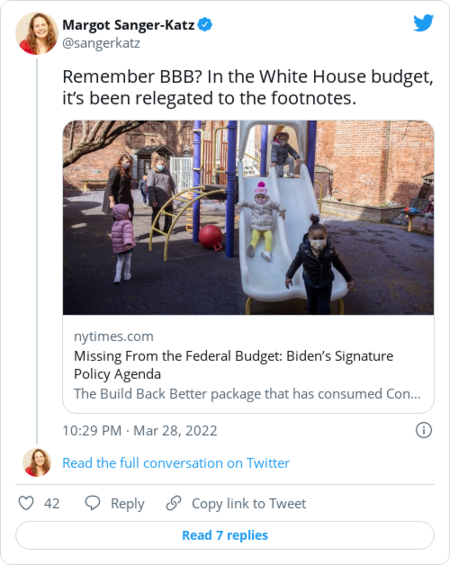 | | | | | Preparing for the next pandemic: The $81.7 billion would go toward long-term pandemic preparedness — and is separate from the stalemate on Capitol Hill over billions in new coronavirus aid. | - The president's budget includes $28 billion for the Centers for Disease Control and Prevention to expand laboratory capacity, boost the public health workforce and strengthen data systems. There's $40 billion for HHS's preparedness office to invest in manufacturing vaccines, therapeutics and diagnostics.
- The National Institutes of Health would get $12.1 billion for researching vaccines and other efforts, and $1.6 billion would go toward the Food and Drug Administration for modernizing information technology and labs.
| | Treating mental health: Both Congress and the White House are ramping up efforts to address the country's mental health crisis, as the pandemic exposed barriers to quickly and easily accessing care. | - The budget includes a proposal to require Medicare and private insurers cover three behavioral health visits per year with no cost-sharing.
- It would eliminate Medicare's 190-day lifetime limit on psychiatric hospital services.
- It contains $697 million to help the country transition to "988" as the three-digit hotline for mental health care.
| | Finding medical breakthroughs: The spending plan allots $5 billion for the new Advanced Research Projects Agency for Health, which would initially focus on finding cures for cancer and diseases like diabetes and dementia. | - But there's still a fight over where to house the entity. In a news conference yesterday, HHS Secretary Xavier Becerra declined to say whether ARPA-H would exist within NIH or as its own stand-alone entity.
| | Budgets are lengthy documents. We combed through it to find some nuggets you may have missed. | - The Centers for Medicare and Medicaid Services estimates that about 4.9 million people will leave the Medicaid rolls between fiscal years 2022 and 2023. The predicted decrease comes as states will face the task of determining who is still eligible for the safety-net program once the Biden administration declares an end to the public health emergency. (h/t to Levitt)
- HHS wants to create a Vaccines for Adults program to cover the cost of immunizations for those without insurance.
- Biden is proposing to remove the word "abuse" from the name of HHS agencies when referring to substance use and addiction. Take the Substance Abuse and Mental Health Services Administration (SAMHSA). The name would change to the Substance use And Mental Health Services Administration.
| | |  | Agency alert | | | We have even more numbers for you today … CMS estimates national health spending growth slowed down after a rise due to covid-19. | | In 2020, national health spending increased 9.7 percent — the fastest rate in nearly two decades. But the growth was just 4.2 percent last year as supplemental funding associated with the pandemic declined significantly, according to a new CMS report. The 10-year forecast: The report estimates that annual growth in health spending is expected to average 5.1 percent over 2021-2030 — and reach nearly $6.8 trillion by 2030. Growth in the nation's gross domestic product is also projected to be roughly 5.1 percent annually over that same time period. That means health care is expected to account for nearly a fifth of the U.S. economy in 2030 — roughly the same as in 2020. | | Cynthia Cox, Kaiser Family Foundation: | 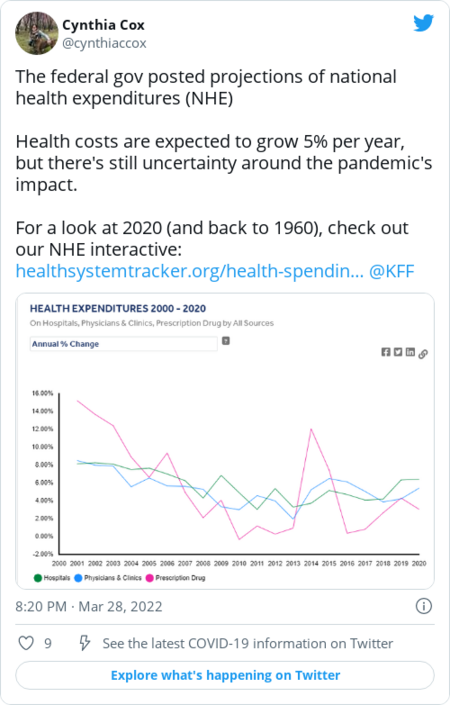 | | | | | |  | White House prescriptions | | The White House's latest effort to thwart covid-19: Clean indoor air | 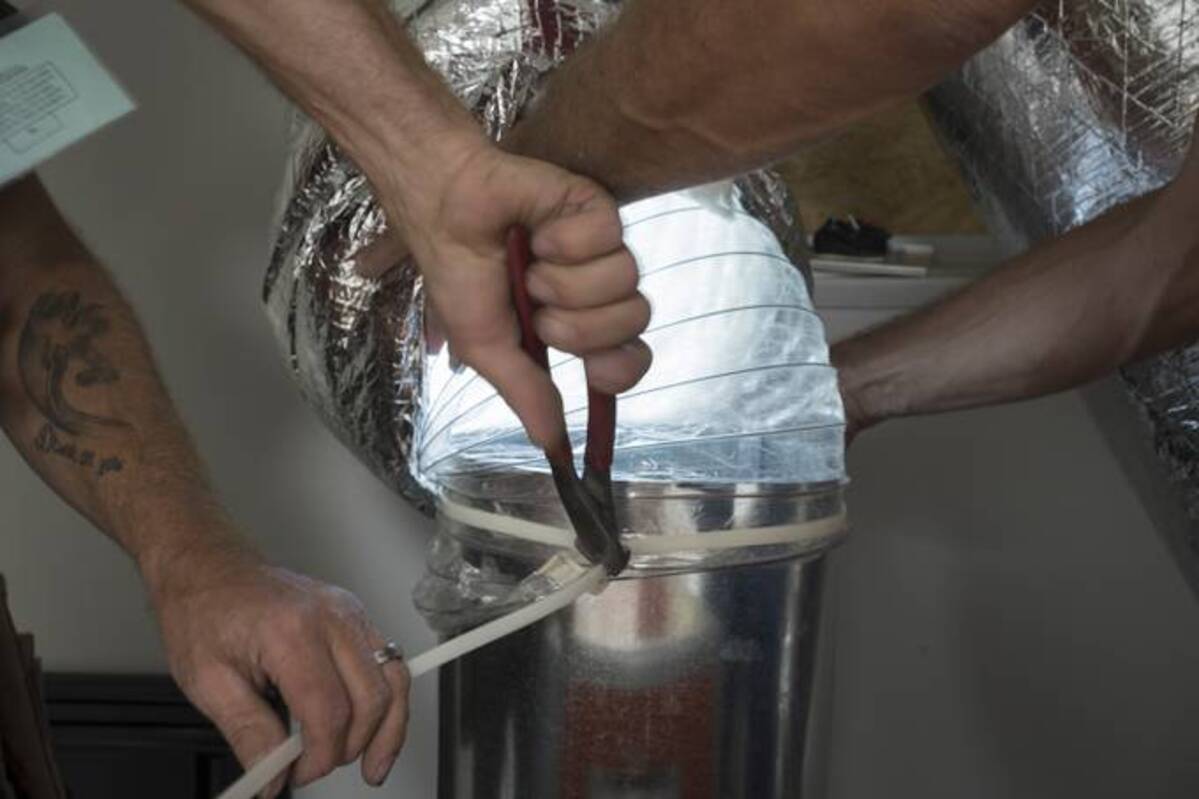 Making improvements to indoor air filtration systems has been shown to significantly reduce coronavirus transmission rates. (Youngrae Kim/The Washington Post) | | | The Biden administration is emphasizing airborne transmission as the primary driver of coronavirus infections — a reversal from federal guidance issued earlier in the pandemic, our colleague Dan Diamond reports. On tap today: The science behind clean indoor air will be featured at a virtual event hosted by the White House science office this afternoon. Health officials had initially maintained that the virus was most often spread through droplets from a nearby person. The focus was on mitigation measures that prioritized avoiding direct contact between individuals, like social distancing and masking. But the virus is often transmitted through small particles in the air that are aerosolized and can travel long distances — a dynamic requiring different approaches to curbing the spread. Under the American Rescue Plan, $122 billion for schools and $350 billion for state, local and tribal governments are available to support improving ventilation, filtration and clear indoor air, the White House wrote in a blog post last week. | | Alondra Nelson, acting White House science director: |  | | | | | |  | Coronavirus | | U.S. reaches a new pandemic milestone | 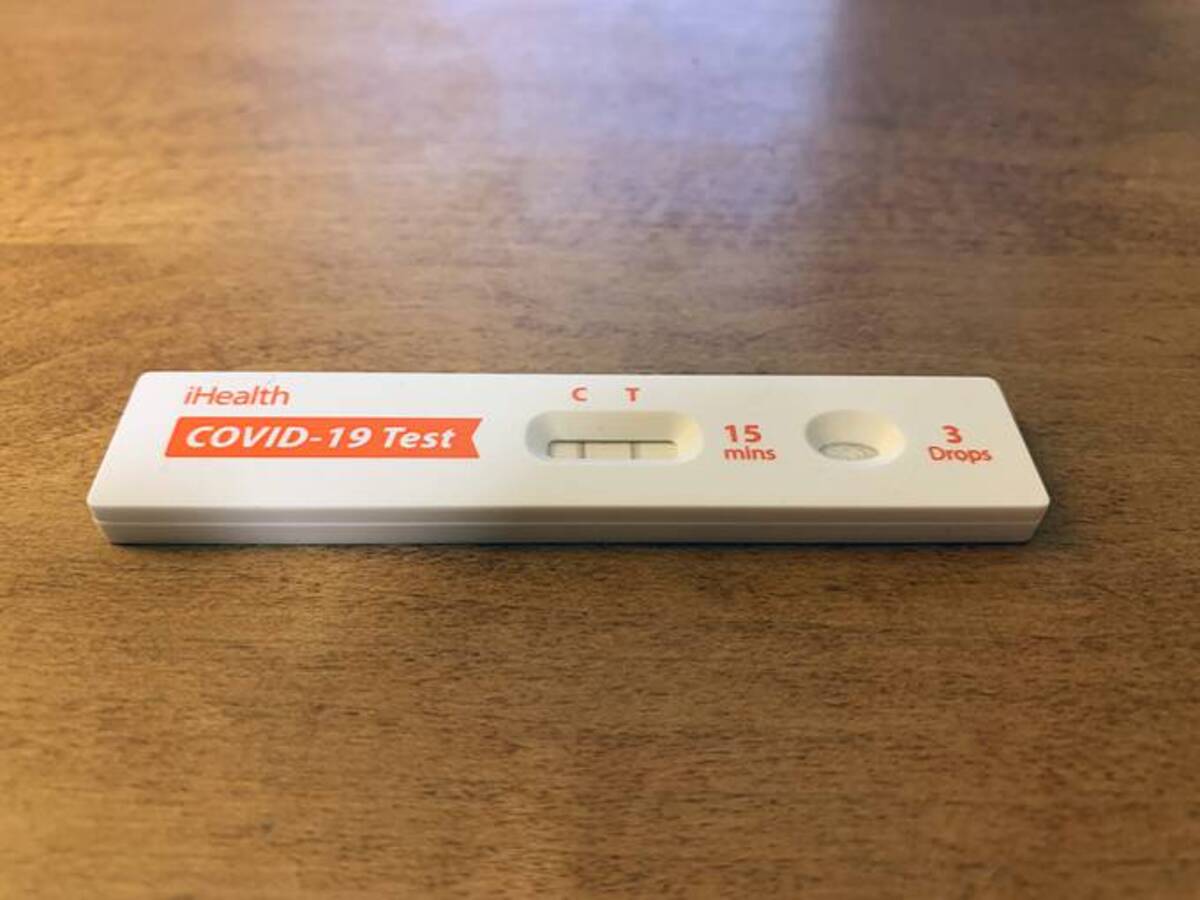 A positive coronavirus rapid test taken at home during January 2022. (Bronwen Latimer/The Washington Post) | | | A majority of Americans have contracted the coronavirus, according to a new poll by Monmouth University that suggests infection rates have been disproportionately higher among Republicans, our colleague Aaron Blake reports. By the numbers: | - 52 percent of respondents said they've personally contracted the virus, up from 40 percent in late January.
- 57 percent of Republicans said they've been infected, compared with 38 percent of Democrats. This tracks with polls that more narrowly surveyed self-reported positive tests, and similarly suggest the gap has grown since the pandemic began.
| | "NBC Nightly News" aired the first episode last night of their investigative series into how the U.S. government's spending during the pandemic led to the "biggest fraud in a generation." What they found: | - Individuals and organized crime groups used stolen identities to claim jobless benefits from state workforce agencies disbursing federal funds, which could be worth up to $30,000 in benefits per identity.
- Other borrowers created fake companies or inflated their number of employees to receive government-backed loans that would be forgiven if the funds were spent on business expenses through the Paycheck Protection Program.
| | How it happened: Government officials said the cause of the widespread fraud was rooted in the government's attempt to respond quickly to the pandemic and make the application process simple at the expense of security. But others argued that the government could have employed fraud prevention safeguards, such as technology commonly used by banks to rapidly verify customers, in the early days of the loan program to cut down on stolen funds. Meanwhile … more pandemic aid has been stalled on the Hill for roughly three weeks. Republicans have demanded a full accounting of where the roughly $6 trillion in stimulus money adopted since the pandemic aid has gone. The administration has been pleading its case, arguing that funding for critical programs could lapse. One such program already has. Our colleague Amy Goldstein has a deep dive out on the over 50,000 health providers that can no longer claim reimbursement from HHS for coronavirus testing and care of those without health coverage. According to the Health Resources and Services Administration, it has been spending about $2 billion a month lately on the program. | | Lester Holt, anchor of "NBC Nightly News": | 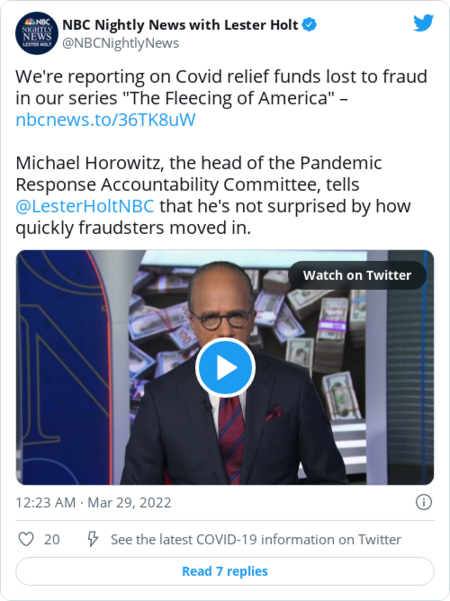 | | | | | |  | Policy watch | | | Legalizing marijuana: House Democrats are poised to pass legislation this week to legalize marijuana and eliminate criminal penalties associated with the drug. But the measure would face an uphill battle in the Senate, The Hill reports. On Wednesday, the House Rules Committee is set to take up the bill, meaning it could get a vote on the floor later this week. Capping insulin: The House will likely vote on a bill Thursday to cap out-of-pocket insulin costs at $35 per month, according to a senior Democratic aide familiar with the matter. Lowering the cost of the life-saving medication is politically popular, and doing so was included in Democrats' stalled economic package. But the vote comes as the Senate is working on a broader bipartisan insulin bill aimed at driving down the list price of the medication, as well as capping its cost for patients. Meanwhile, at the FDA: A panel of advisers will take a nonbinding vote Wednesday on whether an experimental medication for the debilitating illness ALS should be approved. This comes as patient advocacy groups and lawmakers are pressuring the agency to greenlight the drug, the Associated Press reports. But on Monday, federal regulators issued a negative review of Amylyx Pharmaceuticals' study of their ALS drug, which they said was missing data, contained errors in enrolling patients and had "only a modest" effect on slowing the effects of the neurodegenerative disease in patients. | - Flashback: This is the first time the FDA will convene the panel after it went against its advisers' advice last June in approving Biogen's controversial Alzheimer's drug.
| | |  | Health reads | | By Tyler Pager, Sean Sullivan and Michael Scherer | The Washington Post ● Read more » | | | | | |  | Sugar rush | | | Thanks for reading! See y'all tomorrow. | |