| What is causing such high gas prices? That's a question you can expect politicians to be fighting over straight through to November's midterm elections. The answer isn't so straightforward. Let's see what major players say. Americans say: Well, they're kind of split. A March AP-NORC poll found a 55 percent majority said higher gas prices were more the result of factors outside of the president's control, while 44 percent said President Biden's policies were to blame. 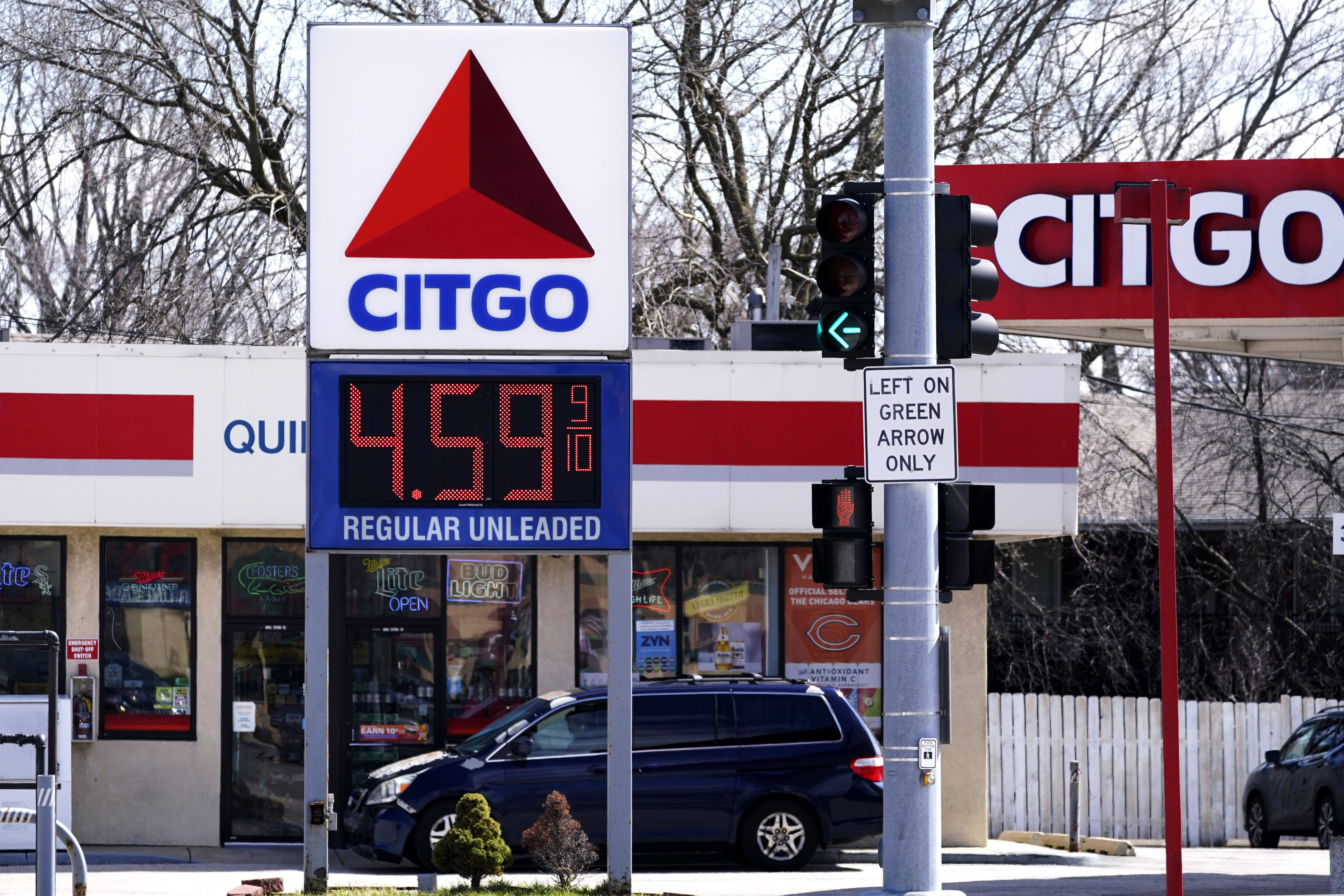 Gas prices in Rolling Meadows, Ill., on Friday. (Nam Y. Huh/AP) | Republicans say: They're blaming Democrats, arguing their pro-climate policies are raising prices. But presidents have little real power over gas prices, since oil is a global commodity. Democrats say: They're blaming Russia for invading Ukraine. "Putin's gas hike," Biden regularly says. But while war is definitely exacerbating prices, the United States didn't import a ton of Russian oil before it banned it. And gas prices were rising before the Russian invasion. Oil executives say: A number who testified to Congress today about high gas prices said it's a mix of problems. "War, inflation, severe supply constraints … lacking a lot of equipment," said Scott Sheffield, CEO of Pioneer Natural Resources. He also said after the recent economic downturns, companies can't find workers. "Who wants to come back and work in the oil and gas industry? We just can't get people back." Experts say: "No one really knows what moves oil prices and the market," Meg Jacobs, an energy expert and author of "Panic at the Pump," told me recently. There are some obvious factors, like all the things we listed above. But oil markets are volatile — they can rise and fall in an instant, and they're often tied to unpredictable global politics. Okay, but how do we lower prices? Drilling more oil would increase supply, making gas cheaper for Americans. So far, experts such as Jacobs say, American oil companies haven't been doing that. (They testified Wednesday that they need more permits to drill on federal land.) But, as Republicans point out, some Democrats attacked oil executives months ago for drilling too much in light of climate change. For some Democrats, the impending midterms are overshadowing their ongoing climate concerns. Right now, they need to figure out how to lower prices before the November elections, when history suggests voters will almost certainly punish them for it. "There's nothing I can paper over with people to make them believe things are getting better until the damn price comes down," vulnerable House Democrat Elissa Slotkin of Michigan told The Post's Marianna Sotomayor and Tony Perry. The government keeps pausing student loan payments for millions Biden announced today that people who have federal student loans won't have to make payments on them until September. President Donald Trump paused student loans — and evictions and foreclosures — in March 2020, and he and Biden both pushed the date for loan payments back repeatedly. The Trump administration said student loans would be paused until "the economy has stabilized, schools have reopened, and the crisis brought on by the COVID-19 pandemic has subsided." Raising the question: How do we know when we've arrived there? Biden says we're not there yet. He argued today that with food and gas prices skyrocketing, now isn't the time to make people restart a payment for something they haven't paid in two years. Some liberals, such as Sen. Elizabeth Warren (D-Mass.), and even Senate Majority Leader Charles E. Schumer (D-N.Y.) want him to go further and cancel federal student loan debt entirely, arguing it's a disproportionate drag on the economy. Biden probably won't do that. But he could use executive orders to extend the pause on student loan payments through his whole presidency. He would not, however, have control over what happens when he leaves office. What is the Supreme Court's shadow docket?  The Supreme Court. (J. Scott Applewhite/AP) | Today, Chief Justice John G. Roberts Jr. criticized his colleagues — including his fellow conservatives — for using the shadow docket to make a pollution ruling in favor of oil and gas companies. He called it an abuse of the court's emergency powers. But what is the shadow docket, anyway? Let's step back a minute. The Supreme Court typically moves slowly. Justices take months to hear and decide a case. For example, the court heard a case on abortion in December that could cut or end abortion protections in the United States. It will probably announce its decision in June. But the court has a process to make decisions more immediately. People can ask the court for an emergency order — when an inmate is trying to fight the death penalty, for instance. The justices make a quick decision without a full briefing or oral arguments, and they don't have to explain their reasoning. Thus, the term shadow docket. (It's not an official term but one used by the court's critics of this practice.) The Post's Robert Barnes reports that the court's use of the shadow docket to make decisions has increased since its conservatives gained a 6-to-3 majority last year. After conservatives on the court let Texas's six-week abortion ban stand this way, liberals — including justices on the court — have accused conservatives of making major policy changes by shadow docket. The majority "barely bothers to explain its conclusion," Justice Elena Kagan wrote in the Texas case. | 



 Email
Email 
