| Good morning, and happy spending bill reading to those gearing up for 2,741 pages. Spot any gems? Send 'em to rachel.roubein@washpost.com. Today's edition: We break down the health-related provisions in the omnibus, including $1 billion to establish President Biden's proposed agency to speed up medical breakthroughs and increases to key agencies. And there could be a new strategy for the antiabortion movement on the horizon. But first … | Congress may allow the FDA to regulate synthetic nicotine | 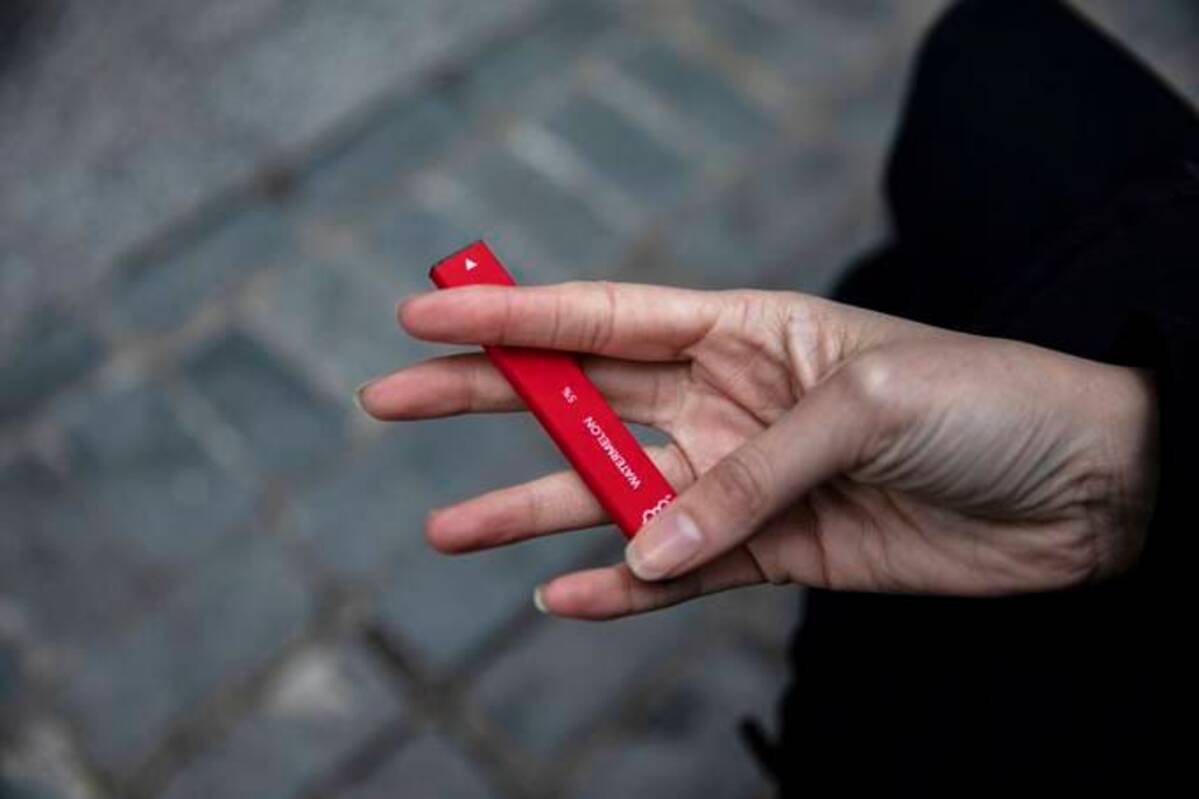 Congress is planning to give the Food and Drug Administration the power to regulate synthetic nicotine. (Marshall Ritzel/AP) | | | Congress is taking a big step in cracking down on the latest youth vaping trend. A provision tucked inside the massive government funding bill gives the Food and Drug Administration authority over synthetic nicotine, our colleague Laurie McGinley reports. Some vaping manufacturers have switched to synthetic nicotine to sidestep agency regulation in recent years, and the new congressional effort is meant to close the loophole decried by lawmakers and anti-tobacco advocates. | - "This bipartisan legislative fix will help protect our kids from highly addictive products like flavored e-cigarettes containing synthetic nicotine — which have fueled the youth vaping crisis — by ensuring there's FDA oversight of all synthetic nicotine products," Sen. Patty Murray (D-Wash.), the Senate HELP Committee chair, said in a statement to The Health 202.
| | Congressional negotiators dropped the much-anticipated, 2,741-page package early this morning. It includes $15.6 billion in coronavirus aid, $1 billion to launch President Biden's new Advanced Research Projects Agency for Health and an increase in funds to combat the opioid epidemic. (See below for a breakdown of all the health-related provisions.) Though the synthetic nicotine provision may be one of the package's less prominent policies, it could have an outsize impact. | - "There has never been a more blatant attempt to circumvent regulation," Matthew L. Myers, president of the Campaign for Tobacco-Free Kids, told Laurie. "Some companies announced they were using synthetic nicotine for exactly that purpose."
| | The rise in synthetic nicotine is linked to the overall effort to curb e-cigarette use among young people, which former FDA commissioner Scott Gottlieb called an "epidemic" back in 2018. Take the popular Puff Bar brand, Laurie explains. In 2020, sales of its products increased after the FDA temporarily barred sweet and fruity e-cigarettes featuring refillable cartridges. | - Yet, those restrictions didn't apply to Puff Bar's products since they're not refillable.
- Anti-tobacco advocates were upset. So in July 2020, the agency ordered the company's products off the market.
- But last year, Puff Bar came back with a synthetic nicotine formula that federal regulators had no authority over.
| | The omnibus is likely to pass. Assuming it does, makers of synthetic nicotine products must file an application seeking authorization from the FDA within 60 days of the law's enactment. Products would no longer be legal if they're not authorized within 120 days of the bill's package. The impact: Industry officials told Laurie they were doubtful that companies would apply for permission to sell synthetic nicotine products, since some had been hoping to avoid FDA scrutiny. And even if they did, they'd need to have the scientific data to meet the agency's standard for granting marketing clearance, meaning the product is "appropriate for the protection of public health." But vaping advocates disagreed. They argue that synthetic nicotine provides a way for cigarette smokers to switch to e-cigarettes. | | The package released early this morning comes after congressional negotiators spent months hashing out a long-term deal to fund the government. | | The massive package includes … | - $15.6 billion in coronavirus aid, including roughly $5 billion for global efforts;
- An $11.3 billion increase above fiscal year 2021 for the Department of Health and Human Services;
- $1 billion to create Biden's proposed new agency to spur biomedical research;
- $4.2 billion — a 9 percent increase — across HHS to address the opioid epidemic;
- A $77.6 million increase to transition to "988" as the three-digit suicide prevention hotline;
- A 19.8 percent increase for the Strategic National Stockpile;
- And increases to both the Centers for Disease Control and Prevention (7 percent) and the National Institutes of Health (5.3 percent).
| | Here's some other provisions we noticed: The Hyde Amendment lives on. Democrats had pledged to repeal the long-standing restriction barring using federal funds for abortions in most circumstances. But doing so didn't stand a chance in the Senate, where 10 Republican votes are needed. Keeping the territories' Medicaid programs afloat. Congress is allowing the federal government to match the territories' Medicaid dollars at the traditional rate. An extension of telehealth flexibilities. Emergency powers during the pandemic allowed telehealth to boom, but such policies would go away with the public health emergency. The spending bill would allow for those measures to continue roughly five months after the PHE ends. (Reminder: The declaration is renewed in 90-day increments, and the Biden administration has not said when it plans to let it lapse.) | | |  | Reproductive wars | | A new strategy for antiabortion groups could be on the horizon | 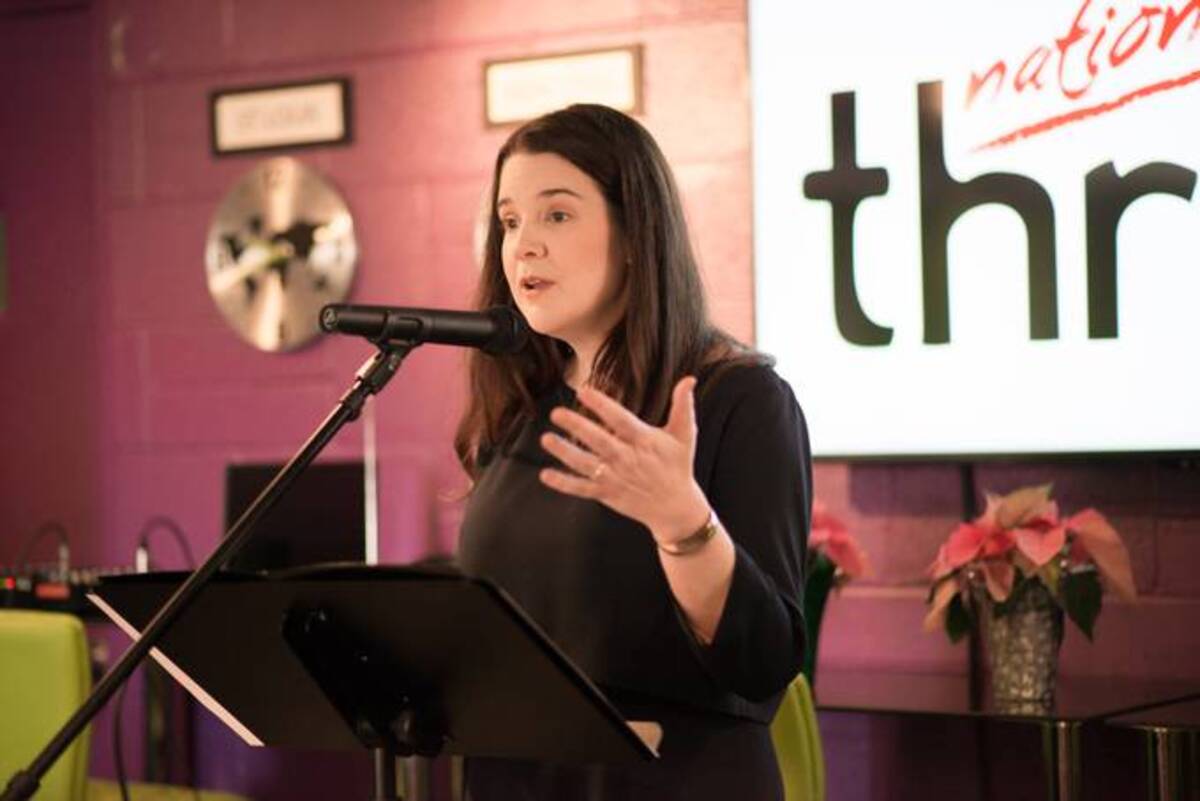 Missouri state Rep. Mary Elizabeth Coleman's proposed legislation is modeled after an abortion measure Texas legislature passed earlier this year. (Neeta Satam/The Washington Post) | | | A prominent antiabortion lawmaker in Missouri introduced a measure that would allow private citizens to sue anyone who helps a Missouri resident obtain an abortion out of state, The Post's Caroline Kitchener reports. The effort is meant to squash a predictable pattern: Whenever a Republican-led state imposes new restrictions on abortion, those seeking the procedure cross state lines to find treatment in places with less stringent laws. Similar travel patterns have emerged in places like Texas, which is the only state with a near-total ban on abortions. | - "If your neighboring state doesn't have pro-life protections, it minimizes the ability to protect the unborn in your state," said Missouri state Rep. Mary Elizabeth Coleman, a Republican.
- But abortion rights advocates counter that the provision is unconstitutional because it would essentially extend state laws beyond their jurisdiction.
| | Laurence H. Tribe, an American legal scholar and university professor emeritus at Harvard Law School: | 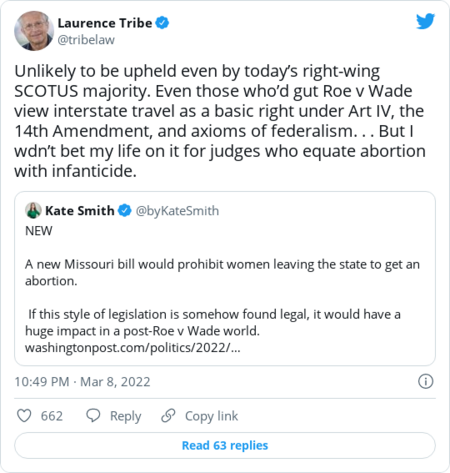 | | | | Meanwhile, WHO updates guidance on abortion services prescribed remotely | | For the first time, the World Health Organization updated its guidelines Tuesday to recommend telemedicine as an alternative to in-person visits with health-care providers to deliver abortion services, such as medications or counseling. Key findings: | - Across 10 studies, WHO officials found no difference in rates of successful abortions between women prescribed via telemedicine compared with in-person care services.
- But referrals for surgical intervention were lower for women who used telemedicine.
| | |  | Coronavirus | | Long covid patients fight for disability benefits | 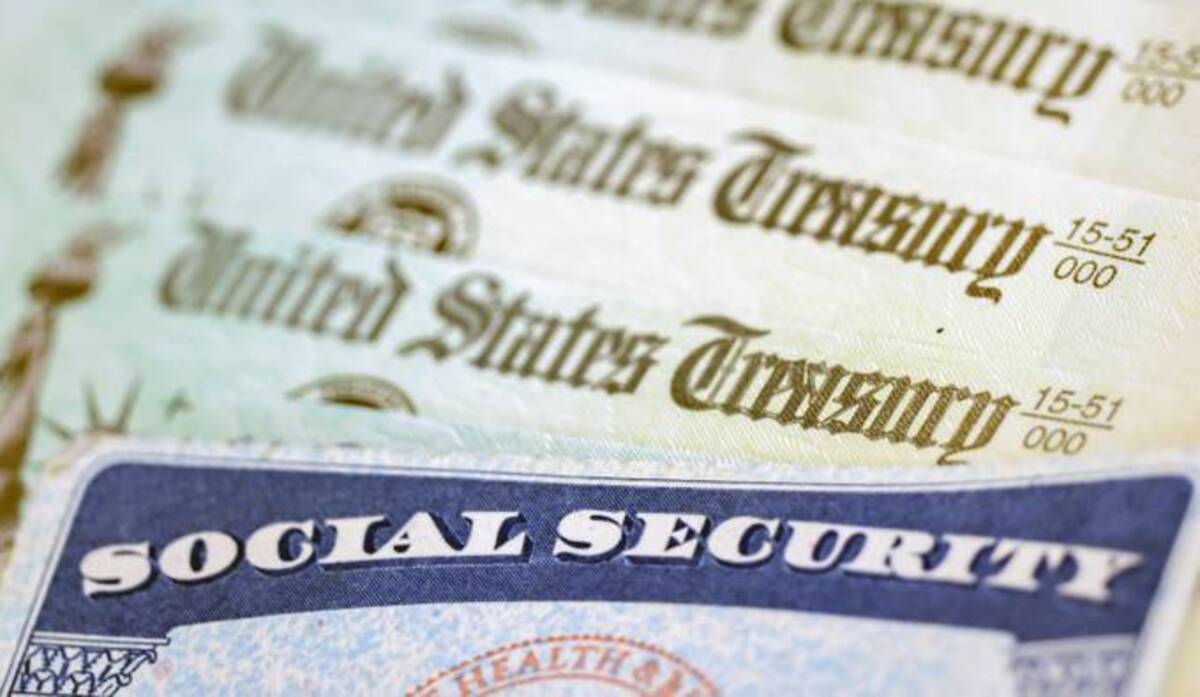 Long covid-19 patients say they are being forced to go back to work while their symptoms continue to make daily life difficult. (Kevin Dietsch/Getty Images) | | | Patients suffering from long covid-19 are at odds with private insurance companies and the Social Security Administration about whether their symptoms qualify them for disability benefits, our colleague Christopher Rowland reports. Zooming out: Covid-19 has infected more than 79 million people in the United States, and of them, several medical specialists said up to 1.3 million patients are likely so sick for extended periods of time that they can't return to work full time. | - Covid-19 long-haulers report experiencing a variety of symptoms including extreme fatigue, brain fog and shortness of breath.
- But patients told The Post that they are having trouble meeting the evidence threshold required by insurers for disability payouts because many of their ailments don't show up on traditional medical tests.
| | The SSA said it has received roughly 23,000 disability applications since the start of the pandemic that included a mention of covid-19, but declined to say how many have been denied. But agency spokeswoman Nicole Tiggemann told The Post that "disability evaluations are based on function," determined by medical tests, "not diagnosis." Yet … the Centers for Disease Control and Prevention cautions in its guidance that "Lack of laboratory or imaging abnormalities does not invalidate the existence, severity, or importance of a patient's symptoms or conditions." | - "A lot of times, the insurance company is just looking at the physical requirements and saying … nothing precludes you from sitting at a desk all day," said Mark D. DeBofsky, a lawyer who represents patients fighting for benefits. "But you have to think, you have to analyze, you have to plan, you have to use judgment. If you are not able to fully exercise those faculties, you can't work at that job."
| OSHA to begin covid-19 focused inspections | | The Occupational Safety and Health Administration announced that it will ramp up inspections of hospitals and nursing facilities that care for covid-19 patients over the next three months to assess their readiness to address future surges or emerging variants of the virus. The goal of the initiative is to control the spread of the coronavirus and protect those workers at high risk of contracting the virus by ensuring that employers are compliant with the agency's pandemic guidance. | - For instance: OSHA officials will look at workplaces that received citations during the pandemic, or where complaints were made.
- Facilities will be assessed, in part, on their protocols for protective personal equipment use, verification of vaccinations, and whether they've implemented covid-19 preparedness, response and control measures for future outbreaks.
| | |  | In other health news | | - The Biden administration said it will ask Congress to approve $150 million over the next three years to assist the global effort to produce new vaccines within 100 days of the arrival of future biological threat, the New York Times reports.
- An expert group convened by WHO said it "strongly supports urgent and broad access" of coronavirus vaccines and boosters, reversing its previous statement that said wealthier countries should refrain from using additional doses until developing nations can administer initial rounds of the shot for their populations.
- Hawaii will become the last state in the nation to drop its universal indoor mask mandate on March 26 as covid-19 cases and hospitalizations steadily decline across the country, the Associated Press reports.
| | Hawaii Gov. David Ige (D): | 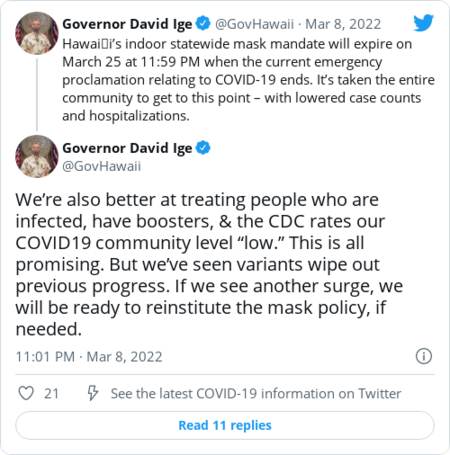 | | | | | |  | Health reads | | By Rae Ellen Bichell l Kaiser Health News ● Read more » | | | | | |  | Sugar rush | | | Thanks for reading! See y'all tomorrow. | |