 | | Maxine Joselow | | | Good morning and welcome to The Climate 202! In keeping with our theme of mentioning cats this week, ICYMI, the Russian Cat Federation has banned Russian cats from competitions. 😿 Speaking of which … | To ban or not to ban: White House, Congress grapple with U.S. imports of Russian oil |  White House press secretary Jen Psaki during a briefing March 3. (Patrick Semansky/AP) | | | Washington policymakers on Thursday sought to pressure Russia into abandoning its war on Ukraine by leveraging a crucial weapon: energy. But a key divide emerged yesterday between the White House, which sought to tamp down talk of banning Russian oil imports, and congressional lawmakers of both parties, who voiced increasing support for a ban to squeeze one of Moscow's most lucrative industries. Throughout the debate, the specter of President Biden's climate agenda loomed large. Republicans and industry groups argued that Biden should temporarily put aside his climate concerns and increase domestic fossil fuel production to counter soaring gas prices, while Democrats rejected such arguments outright. Here's what to know about the discussion in Washington over the climate and energy implications of the Ukraine crisis, which comes about a week after Russian forces entered Ukraine: | White House waffles on a ban | | At her daily briefing, White House press secretary Jen Psaki sought to walk a fine line when it came to blocking shipments of Russian oil into the United States, Maxine and our colleagues Tony Romm and Rachel Siegel report. Psaki said that while Russian oil only accounts for about 10 percent of U.S. oil imports, the United States does not have a "strategic interest" in reducing global energy supply, which could further raise gas prices domestically. But she signaled that the Biden administration is looking broadly at policy steps it might take to target Russia's energy sector. (The United States imported an average of about 198,000 barrels of Russian oil per day in 2021, according to federal estimates.) | | "We are continuing to look at other options we could take right now to cut U.S. consumption of Russian energy," she said. "Reducing the supply out there would have an impact on prices." The Ukraine conflict has roiled global energy markets in recent days, with West Texas Intermediate prices reaching $116 per barrel in premarket trading on Thursday for the first time since 2008. Gas prices hit $3.72 per gallon yesterday, according to a national average from AAA, marking a significant rise from $2.66 a year ago. | | Seeking to counter such price increases, a bipartisan and bicameral group of lawmakers on Thursday introduced legislation to prohibit imports of Russian crude oil, petroleum products, liquefied natural gas and coal into the United States. The measure was spearheaded by Sens. Joe Manchin III (D-W.Va.) and Lisa Murkowski (R-Alaska), who both hail from fossil-fuel-producing states. A companion bill was introduced in the House by Reps. Josh Gottheimer (D-N.J.) and Brian Fitzpatrick (R-Pa.). "Revenue from oil and gas keeps [Russia] afloat," Sen. Lindsey O. Graham (R-S.C.) said during a news conference announcing the bill. "If we can isolate the oil and gas sector [and] produce more here at home, that will do more to end this war than any single thing I can think of." The measure got a high-profile boost yesterday from House Speaker Nancy Pelosi (D-Calif.), who told reporters at her weekly news conference: "I'm all for that. Ban it." | Ripple effects on climate policy | | Energy industry groups and several GOP lawmakers, meanwhile, urged the Biden administration to prioritize boosting domestic fossil fuel production over pursuing its aggressive climate agenda — at least for the time being. The American Petroleum Institute, the U.S. oil and gas industry's largest trade group, yesterday called on Biden officials to resume oil and gas leasing and permitting and to speed approvals of new liquefied natural gas facilities. | | "This administration continues to show that they are committed to talking about lowering gas prices and committed to restricting access to the oil and gas that will help lower gas prices," Frank Macchiarola, the trade group's senior vice president for government relations, said on a call with reporters yesterday. Murkowski told reporters that while Biden campaigned on a promise to take ambitious climate action, the crisis in Europe should supersede that pledge for now. "I get that Biden ran on [climate] in large degree," she said. "But we were not, as a world, watching a war in Ukraine. … We are in a different place." However, Manchin said at the briefing that he continues to support the climate and clean energy provisions in Biden's stalled social spending plan, formerly known as the Build Back Better bill. "Absolutely, we have to go forward with our climate solutions," he said. "I'm all for that." | | |  | On the Hill | | Senators grill pipeline regulators over climate policy on natural gas projects | 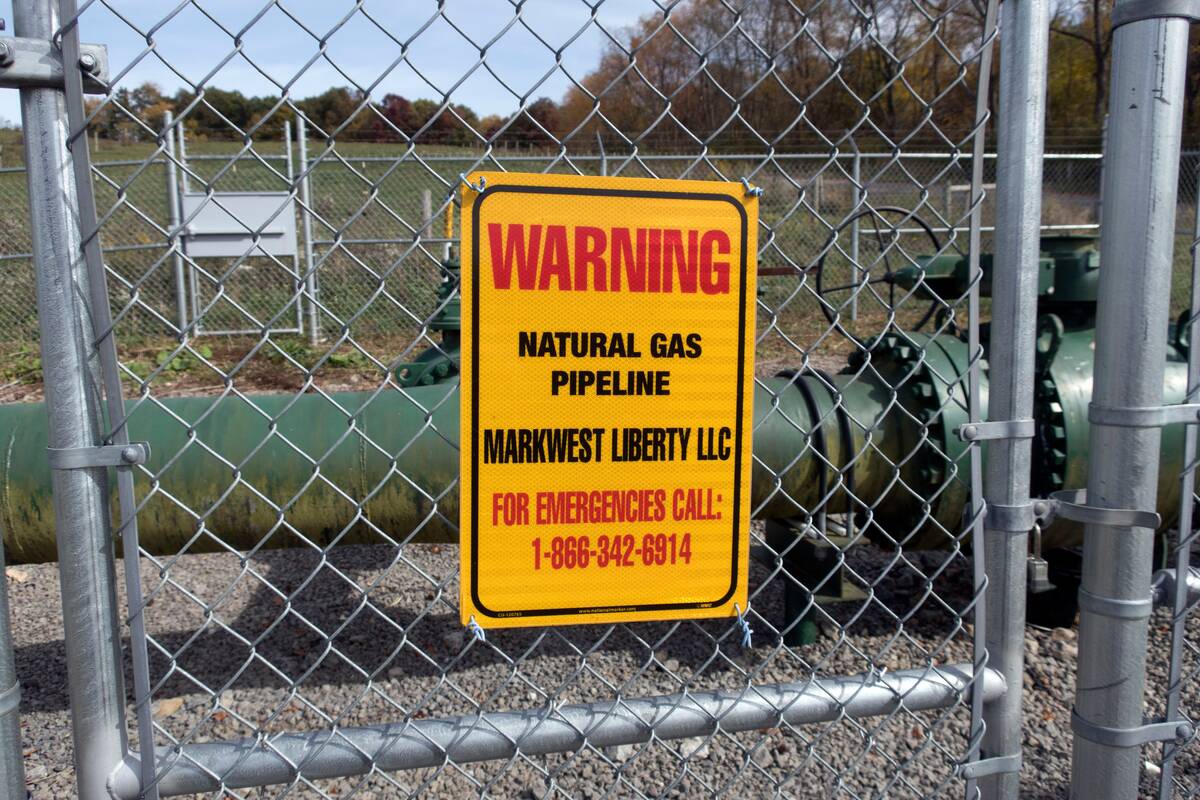 A natural gas pipeline and fracking well cap in Valencia, Pa., on Oct. 14, 2020. (Ted Shaffrey/AP) | | | Democrats and Republicans on the Senate Energy and Natural Resources Committee on Thursday grilled all five members of the Federal Energy Regulatory Commission on their recent move to consider the climate effects of pipelines and related natural gas infrastructure. The three Democrats on the commission voted February 17 to consider how natural gas projects affect greenhouse gas emissions and environmental justice communities. The two Republicans on the commission opposed the guidance, which marked the first update to FERC's pipeline policy since 1999. | | Energy and Natural Resources Chairman Joe Manchin III (D-W.Va.) joined Republicans in blasting the guidance at the hearing, saying, "In my view, there is an effort underway by some to inflict death by a thousand cuts on the fossil fuels that have made our energy reliable and affordable." FERC Chairman Richard Glick, a Democrat, said the goal of the guidance is to "provide an updated, legally durable framework" for permitting pipelines and liquefied natural gas facilities — one that will prevent federal courts from rebuking the commission's approach in the future. Glick, whose term expires at the end of June, told reporters after the hearing that he would be "honored" to be re-nominated by President Biden for another term, despite the political backlash over his climate focus. "I'm not worried one way or the other," he said. "Whatever happens, happens." | | |  | Pressure points | | On the 150th anniversary of Yellowstone, one-third of its wolves are dead |  A home near Emigrant, Mont. is decorated with gray wolf pelts. (Louise Johns/The Washington Post) | | | In less than six months, hunters have shot and trapped 25 of Yellowstone National Park's wolves, amounting to nearly one-third of the animals' total population — a record for one season, The Washington Post's Joshua Partlow reports. The hunting mostly took place in a part of Montana just beyond the border of the park, where hunting regulations were relaxed last year by the Republican-led state legislature. The result has been "four to five months of basically gloves-off, take wolves out through any means possible," Yellowstone Superintendent Cam Sholly said in an interview. "It is highly concerning to us." Anti-wolf sentiment has been around forever, but it has grown in the West during an era of increasing political polarization. Hunters and some locals say the wolf population needs to be managed because the animals prey on livestock and threaten elk. However, dozens of businesses that depend on wildlife and tourism argue that the wolves are worth more alive than dead. The Interior Department is now reviewing whether to restore Endangered Species Act protections to the gray wolves of the Northern Rocky Mountains. Interior Secretary Deb Haaland recently warned Montana officials that their actions "jeopardize the decades of federal and state partnerships that successfully recovered gray wolves in the northern Rockies." | Clean energy, electric vehicles gained traction in 2021, report says |  A Mercedes-Benz electric vehicle inside a showroom in Berlin. (Krisztian Bocsi/Bloomberg News) | | | Despite the coronavirus pandemic, 2021 was a banner year for the growth of clean energy and zero-emission vehicles in the United States, according to the 2022 Sustainable Energy in America Factbook published Thursday by BloombergNEF and the Business Council for Sustainable Energy. Analysts found that electric vehicle sales nearly doubled over the past year, amplifying the need to secure critical minerals used in the batteries of climate-friendly cars. The factbook also noted that while natural gas remained the largest source of U.S. power generation in 2021, consumers and large corporations rapidly shifted toward clean energy, with developers building a record 37 gigawatts of wind and solar generating capacity. In addition, a record-breaking $105 billion in new capital went into U.S. clean energy assets, marking an 11 percent increase from the previous year. | | |  | Climate solutions | | Incandescent lightbulbs are out; climate-friendly LEDs are in |  Eliset Gonzalez repairs a lightbulb in Caracas, Venezuela, in May 2019. (Ariana Cubillos/AP) | | | Incandescent lightbulbs have been in use for more than a century, even though much of the electricity they draw escapes as heat, making them modern-day energy hogs, The Post's Tik Root reports. Today, however, incandescent bulbs make up fewer than half of all bulb sales. Advocates say that switching to more efficient bulbs saves electricity, lowers utility bills and avoids planet-warming emissions. LED, or light-emitting diode, bulbs are the most climate-friendly alternative, consuming only 8 watts of energy compared to the 60 watts that an incandescent uses. On President Barack Obama's last day in office, the Energy Department unveiled standards that would have phased out incandescent bulbs by 2020. President Donald Trump reversed that move. The Biden administration is seeking to reinstate the measure. Estimates from the Appliance Standards Awareness Project found that reinstating those standards would result in $20 billion in utility bill savings for consumers and a reduction of 50 million metric tons of carbon dioxide emissions by 2030 — the equivalent of taking about 10 million cars off the road for a year. | In Virginia, abandoned coal mines are transformed into solar farms | 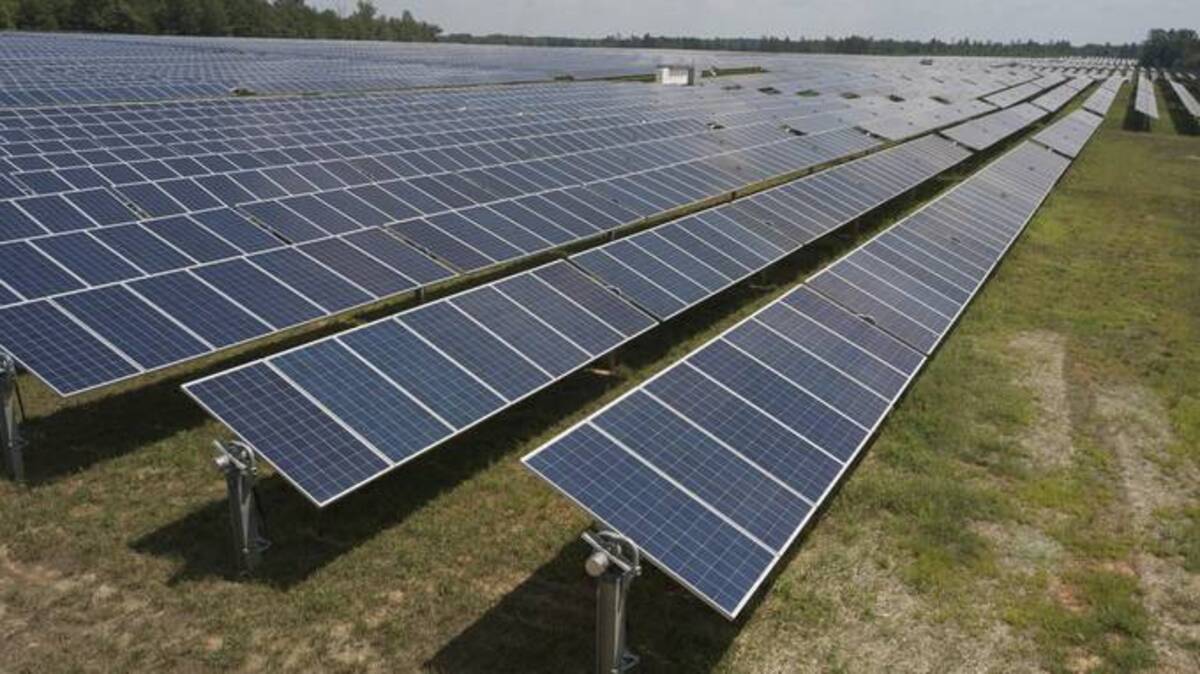 Dominion Energy's Scott Solar farm in Powhatan, Va. (Steve Helber/AP) | | | Six old mining sites owned by the Nature Conservancy in Virginia will become some of the first utility-scale solar farms in the region, a model the nonprofit organization hopes can be replicated worldwide, The Post's Zoeann Murphy reports. In 2019, the Nature Conservancy acquired 253,000 acres of forest in the central Appalachian Mountains that it called the Cumberland Forest Project, which contains several abandoned mine sites. Solar developers partnering with the group, such as Dominion Energy and Sun Tribe, say the sites have vast flat areas exposed to sunlight that are rare in the mountains. The sites also have the advantage of being close to transmission lines. | | |  | Viral | | |