| Florida has, for years, been known in politics as the traditional swing state. But this year, Florida Republicans are passing bills that push more toward the political right. Over the past week, they've passed legislation including: - Banning "discomfort or guilt" conversations in schools or workplaces: If that sounds vague, that's because it is. Florida has already banned discussions about critical race theory in schools. Today, the legislature passed a bill banning workplace trainings or school teachings that make someone "feel guilt" about their identity.
- A 15-week abortion ban: Despite the fact current Supreme Court precedent says abortions are constitutional until about 24 weeks (for now).
- Restricting LGBTQ topics in schools: It will soon be illegal to talk in schools about gender identity and sexual orientation for the youngest students. And it prevents "planned lessons" on LGBTQ issues for older students. And it allows parents to sue schools that ignore the bill.
- Creating the nation's first election police force: Florida will soon have a staff of 25 to investigate voter fraud — even though Florida had a successful 2020 election in a pandemic that the Republican governor touted as the "gold standard." And it makes collecting signed and sealed ballots to drop them off in bulk a crime punishable by $50,000 in fines or five years in prison.
"Who in the world have we become? Who in Florida have we become?" state Sen. Janet Cruz (D) asked during the LGBTQ legislation debate. 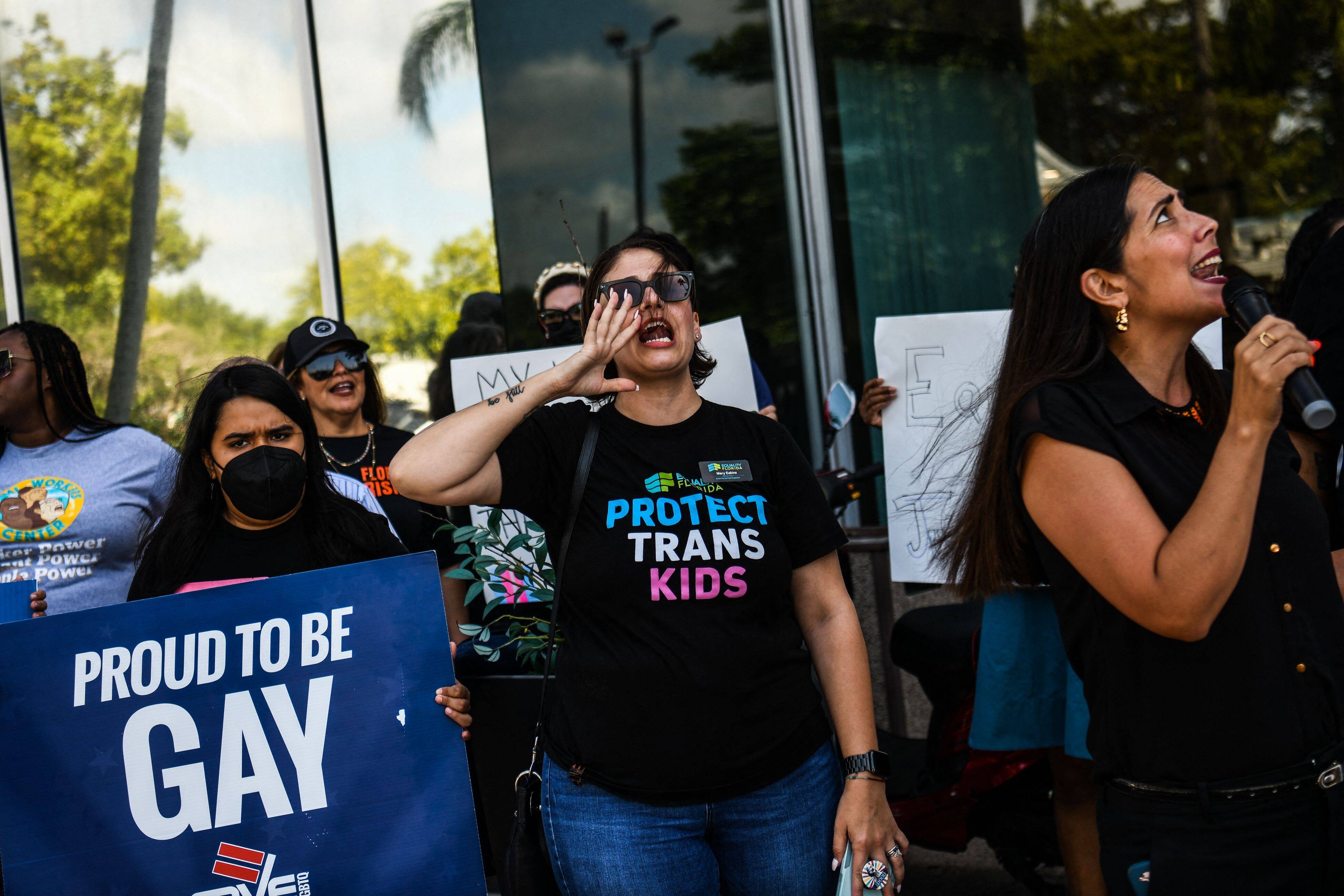 Demonstrators in Coral Gables, Fla., this week. (Chandan Khanna/AFP/Getty Images) | 3 things driving Florida so far to the right 1. Florida's been leaning more Republican lately: For the first time in more than a decade, Florida has more registered Republican voters than Democrats. Republicans control all of the state government. Donald Trump won the state twice. Some of Florida's Latino population is leaning right. Some Democrats worry the state soon won't be a swing state. But the Florida legislature is more conservative than the population in general, said Carlos Curbelo, a former Republican congressman from Florida. That's a result of gerrymandering to keep these legislators in power and closed primaries that elevate voices from the political poles, he said. 2. Gov. Ron DeSantis (R): He wants to run for president in 2024. And to do that, he'll probably have to out-Trump Donald Trump in a primary. (The former president has all but said he's going to run.) DeSantis has calculated it means driving Florida hard to the right. "I also want Florida to be known as a brick wall against all things 'woke,'" he has said. "He's building a résumé that will appeal to GOP primary voters in early primary states," Curbelo said. 3. There's a national conservative push to censor: Florida is far from the only state policing conversations about race or LGBTQ issues in schools. Conservatives who have long campaigned as the party of freedom have found renewed energy in the opposite approach, clamping down on what people and institutions in their states can do or say.
Curt Anderson, a Republican strategist in Florida, argued it's a winning political strategy to legislate what happens in schools. "Most voters have this odd notion that teachers should focus on academics and leave the parenting to the parents," he quipped. How GOP-led states are rushing to restrict abortion access We talked about Florida's 15-week ban on abortion. Idaho is about to become the second state (alongside Texas) banning abortions once a heartbeat is detected. That's typically around six weeks, which is the earliest doctors can detect fetal cardiac activity and before many people know they're pregnant. A Missouri legislator is trying to stop women from seeking abortions even across state lines. This could be just the beginning of antiabortion laws in America. I talked to The Post's Caroline Kitchener, who covers abortion politics. Our conversation has been lightly edited for length and clarity. Q: Why are these states acting as if Roe v. Wade is over? A: States have been doubling down on antiabortion laws since 2011. But the energy and commitment is different this year, because Republican legislators know the most extreme ones (the six-week bans, even the total bans) could take effect, depending on how the Supreme Court rules this summer in a case about Mississippi's 15-week ban, a decision that will determine the future of Roe v. Wade. Republicans are also looking at Texas, where abortion has been illegal after six weeks of pregnancy since September, and they're thinking: If they can do it, why not us? Q: What's next for abortion, both at the state legislative level and in the courts? A: Everyone is waiting for the Supreme Court to rule on the Mississippi case, but a lot of people don't realize that we could see abortion access severely restricted in other states significantly before then. There is quite literally no end in sight for the Texas law, which employed a novel (and extremely controversial) legal strategy to get around the courts, allowing it to take effect where other similar bans were blocked and ruled unconstitutional. A Texas-style ban is moving quickly through the Idaho legislature. Other states, such as Oklahoma, seem poised to quickly pass their own Texas-style bans as well. | 



 Email
Email 
