| It's the most definitive statement from a judge so far about Donald Trump's efforts to overturn his election loss: A federal judge said today he thinks Trump "more likely than not" committed a crime when he tried to stay in power. This opinion alone is not going to land the former president in jail. But it's notable, at least, for the history books. Let's explore. The alleged crime Trump committed: Obstructing Congress's certification of the election for Joe Biden. Congress certifies the winner of the presidential election at the very end of the process. It's more perfunctory than anything else. Its job is to put the stamp of approval on each state's electoral votes and confirm the winner. We know that Trump tried to persuade his vice president, who presided over that certification, and Republican members of Congress to throw the results back to the states, where he hoped to persuade Republican-led legislatures to declare he won. It was his last-ditch effort to stay in power, and it helped lead to the Jan. 6 attack on the Capitol as Congress was certifying Biden's win. Rep. Liz Cheney (R-Wyo.), the vice-chair of the Jan. 6 congressional committee, has also floated obstruction of Congress as a potential crime Trump could be accused of. More than 200 Capitol rioters have been charged with this. 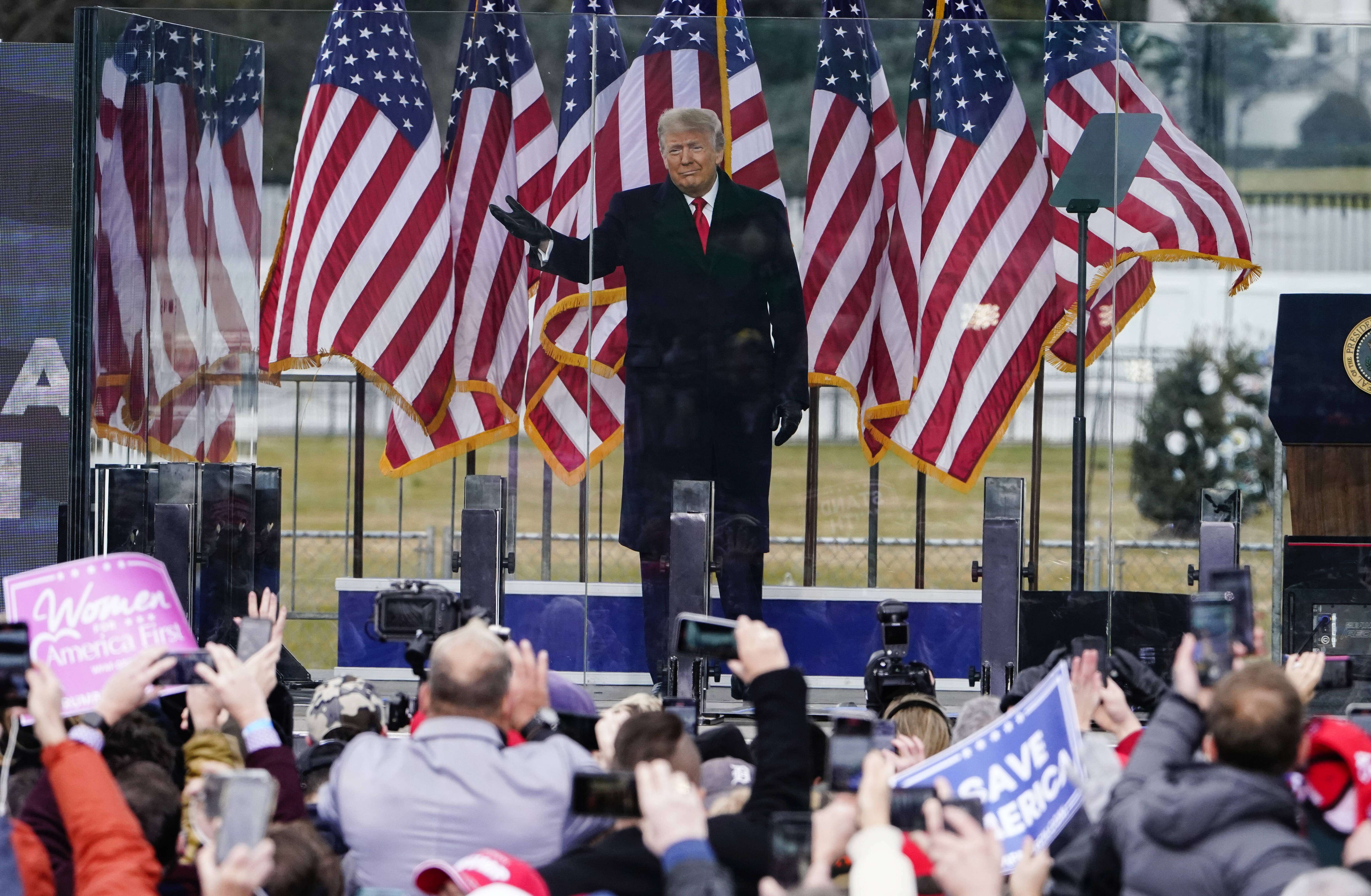 President Donald Trump at his rally on Jan. 6, 2021. (Jacquelyn Martin/AP) | How this judge's opinion came about: One of the crafters of the Trump effort was a lawyer named John Eastman, who was advising Trump at the time and who may have also been working with Sen. Ted Cruz (R-Tex.) on ways to stop Biden's certification, reports The Post's Michael Kranish. The House Jan. 6 committee is so interested in what Eastman was telling Trump that it went to court to get his emails. Eastman argued they were protected by attorney-client privilege, but the Jan. 6 committee argued that because there was a potential crime discussed, those emails aren't privileged. Today, a federal judge said Congress could have most of the emails it wanted and agreed Trump might have committed a crime. The judge wrote: "Dr. Eastman and President Trump launched a campaign to overturn a democratic election, an action unprecedented in American history. Their campaign was not confined to the ivory tower — it was a coup in search of a legal theory. The plan spurred violent attacks on the seat of our nation's government, led to the deaths of several law enforcement officers, and deepened public distrust in our political process." The potential impact of this: The Justice Department is investigating what happened on Jan. 6, but we don't know whether it's investigating Trump directly. The Post's Matt Zapotosky and John Wagner say that having this determination from a judge will probably increase pressure on the Justice Department to investigate Trump's role in all this. What power does the Jan. 6 committee actually have? The other big investigation of Jan. 6 is happening in Congress. It's coming up on a year into its probe. But it's important to remember that whatever members find, they can't send people to jail for it. The power of Congress in this situation is investigatory. Here's a primer on how it works: The committee can and has subpoenaed powerful people to find out what happened: It's even trying to get Ginni Thomas, the wife of Supreme Court Justice Clarence Thomas, to talk about her communication with the White House as she urged it to find a way to keep Trump in power. A subpoena is a legally binding request. It has a relatively weak tool to respond when people ignore its subpoenas: Members can vote to hold people in contempt for not talking to them. A contempt vote carries no legal weight, but it does refer the case to the Justice Department for it to consider prosecuting the person. The committee was set to hold such a contempt vote tonight on two Trump advisers, Peter Navarro and Dan Scavino, who ignored subpoenas to testify to the committee. The committee and the full House has already held former White House chief of staff Mark Meadows and former Trump strategist Steve Bannon in contempt for the same thing. The Justice Department has only charged Bannon, who faces a trial this summer and potential jail time. The rest, as of now, simply don't have to talk to Congress. Can't someone make Supreme Court justices abide by a code of ethics? After we learned that Ginni Thomas frantically texted the White House as Trump was trying to stay in power, readers asked: Shouldn't her husband have to recuse himself from election-related cases on the Supreme Court, and can anyone make him? No to both. It's up to Justice Thomas to decide whether his wife's activism is a conflict of interest. Congress could try to pass a law telling the justices when to recuse themselves. There are rules like that for lower-court judges. But Chief Justice John Roberts has said he thinks that would raise separation-of-power concerns because Congress would be policing a coequal branch of government, said Jessica Levinson, a law professor at Loyola Marymount University. Maybe Supreme Court justices could enforce a code of ethics on one another? Levinson said it's not hard to imagine a world in which justices game the system to try to get their rivals out of a certain case. A reporter asked President Biden to chime in on this Monday and he declined, underscoring that there isn't much political momentum to change the way things are. "[Society] made some legal and policy judgments that we were more comfortable living with this bad situation [of a justice potentially being compromised] than the bad situation where we have a mandatory code of ethics," Levinson said. | 



 Email
Email 
