 | | Maxine Joselow | | E.U.-U.S. Energy Council meeting today has big implications for climate, energy |  Secretary of State Antony Blinken speaks during a Senate Foreign Relations Committee hearing on Sept. 14. (Stefani Reynolds/Bloomberg) | | | Top officials on the E.U.-U.S. Energy Council are set to meet today in Washington, as the United States warns that Russia could invade Ukraine within days. The meeting will be crucial for efforts to bolster Europe's natural gas supplies amid a possible Ukraine invasion, as well as broader efforts to reduce emissions and combat climate change on both sides of the Atlantic. The details: Launched in 2009, the E.U.-U.S. Energy Council is a high-level body that "coordinates on strategic energy issues of mutual interest," according to the Department of Energy. | - The council is led by Secretary of State Antony Blinken, Energy Secretary Jennifer Granholm, E.U. foreign policy chief Josep Borrell and European Commissioner for Energy Kadri Simson.
- This is the first time since 2018 that the council has convened.
| | Here's what to expect at the meeting, according to a State Department spokesman and experts in international climate and energy policy: | Ukraine and Europe's energy security | | Officials will certainly focus on ensuring that natural gas continues to flow into Europe if Russia invades Ukraine. | | "The U.S. and the EU will use this council meeting to move forward our ongoing work to ensure world energy markets are stable and well-supplied," the State Department spokesman said in an email. Nikos Tsafos, an energy expert with the Center for Strategic and International Studies, told The Climate 202 that in the short term, the council will have "limited" options for dealing with the potential disruption. "All you can do is try to attract gas to Europe and ensure there is enough coordination to move the gas where it is needed," he said. "But most Europeans do not think a total cutoff is likely, so they are not planning for that." Tsafos said that record-high energy prices over the past year have "exposed serious cracks in Europe's energy security architecture" in the long term. "I can imagine the council spending some time on the question 'How do we avoid this fate in the future?' This is partly about transitioning away from hydrocarbons. But it's also about safeguarding the system while that transition happens." Europe's reliance on Russian gas also has consequences for the climate. Satellite imagery shows that Russia has allowed its gas pipelines to leak massive amounts of methane, a potent planet-warming gas, according to a recent Washington Post investigation. "The council's immediate task is to line up additional natural gas and other electricity supplies in case Russian gas is cut off," Paul Bledsoe, a strategic adviser at the Progressive Policy Institute, said in an email to The Climate 202. "But the U.S. and EU must also begin to formulate long-term strategies to limit Russian gas reliance on climate grounds, including increasing gas supplies that are lower in methane emissions, and delivering more forms of clean energy and electricity storage." | | The meeting will also be an opportunity to advance E.U.-U.S. collaboration on curbing emissions of greenhouse gases, including carbon dioxide and methane, ahead of the next United Nations climate summit in Egypt in November. | - At the climate summit in Scotland last year, known as COP26, the E.U. and the United States led a global initiative to cut methane emissions by 30 percent by 2030.
- The two major economies could also partner on greening international trade after the E.U. last year announced a Carbon Border Adjustment Mechanism to increase the price of carbon-intensive imported goods.
| | "On the broader agenda, there is lots to talk about," Tsafos said. "The top items on my list would be reducing methane emissions, greening trade, enhancing access to finance for emerging economies, and collaborating in sectors like hydrogen, offshore wind, batteries and others. These are all areas where transatlantic collaboration is essential to meeting the global goals." | | |  | Corporate commitments | | Top companies that vowed to fight climate change have fallen short, study says |  A cargo ship in the North Sea near Wangerooge, Germany, on Feb. 3. (Sina Schuldt/AP) | | | A number of large companies have vowed to achieve net-zero emissions in the coming decades. But some of the world's best-known corporations have not done enough to honor their climate commitments, according to a new analysis, The Post's Steven Mufson reports. The study by the New Climate Institute, an independent climate advocacy organization based in Germany, looked at the plans of 25 corporations that have pledged to reach net zero. It found that on average, existing plans would reduce emissions by about 40 percent — and a significant portion of those reductions would not come until the tail end of the companies' self-imposed deadlines. Eight of the companies also excluded scope 3 emissions, which include the emissions created when their products are used, such as when drivers burn gasoline. Scope 3 emissions typically account for more than 70 percent of corporate emissions, according to MSCI, a financial information firm. None of the companies assessed in the study received the top ranking of "high integrity." Maersk received a second-tier ranking, followed by Apple, Sony and Vodafone. A dozen fell into the ranking of "very low integrity," meaning their plans to reach net zero on deadline were not trustworthy. | | |  | On the Hill | | Senators push back on Postal Service plan for gas-powered delivery trucks |  Mail delivery vehicles at a post office in Boys Town, Neb., on Aug. 18, 2020. (Nati Harnik/AP) | | | Senate Environment and Public Works Chairman Thomas R. Carper (D-Del.) on Friday urged the U.S. Postal Service to abandon plans to spend billions of dollars on a new fleet of gasoline-powered delivery trucks. In a letter to Postmaster General Louis DeJoy, Carper wrote that "the USPS has a prime opportunity to lead the effort to address climate change by transitioning the USPS delivery fleet to electrified vehicles." Carper's missive came in response to a Washington Post article that revealed the Environmental Protection Agency and the White House Council on Environmental Quality last week asked the Postal Service to reconsider its contract for mostly gas-powered trucks, saying the contract rested on an environmental analysis with flawed assumptions and missing data. The contract also only calls for 10 percent of the new delivery trucks to be electric, as DeJoy said the Postal Service couldn't afford more. Sen. Sheldon Whitehouse (D-R.I.) also responded to the reporting by calling for the swift confirmation of President Biden's two nominees to the USPS Board of Governors, which has the sole authority to remove DeJoy. | House passes America COMPETES Act |  Panels on a conveyor belt last year at the First Solar manufacturing facility in Walbridge, Ohio. (Elaine Cromie for The Washington Post) | | | The House on Friday passed the America COMPETES Act, a bill aimed at boosting U.S. competitiveness with China, clearing the way for conference negotiations with the Senate. The House-passed bill authorizes significant environmental spending, including: | - $3 billion in grants to bolster the U.S. solar manufacturing industry.
- $150 million annually for the U.S. Fish and Wildlife Service to combat illegal wildlife trafficking.
- Up to $53 million annually to protect coral reefs from climate change and other threats.
| | |  | The power grid | | Biden continues Trump-era solar tariffs with some changes | 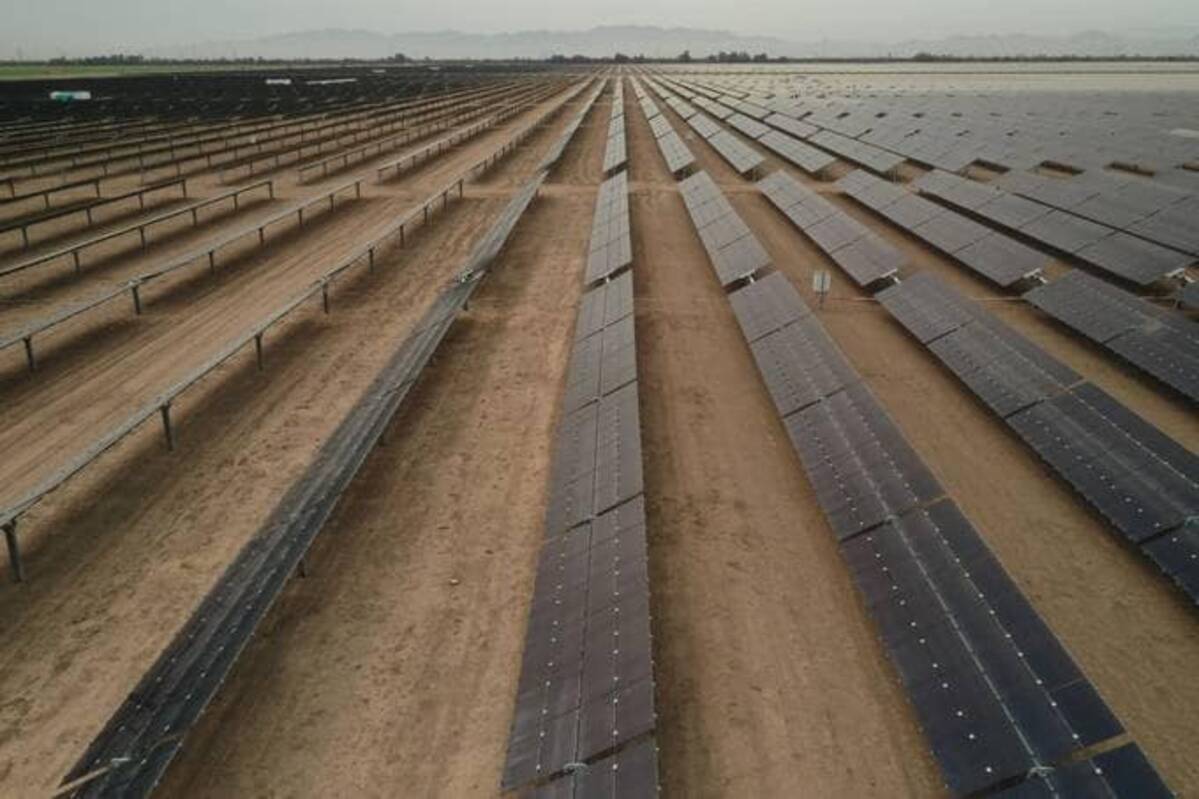 Photovoltaic panels at the Calexico Solar Farm II in California on Sept. 11, 2020. (Bing Guan/Bloomberg News) | | | The Biden administration on Friday extended tariffs on imported silicon solar products, first imposed by Donald Trump in 2018, with several caveats to the existing provisions, the New York Times's Ana Swanson and Ivan Penn report. The decision will double the amount of solar cells that can come into the country without facing tariffs. The administration also said it will begin talks with Canada and Mexico to allow them to freely export products to the United States. In addition, bifacial solar panels, which absorb light on both sides, are spared from the tariffs to allow solar developers to access cheaper foreign products — and to help meet Biden's clean energy targets. Mark Widmar, the chief executive of First Solar, a U.S. solar panel manufacturer that had pushed for tougher restrictions on imported products, criticized the decision. But solar installers that use foreign panels largely praised the move. | | |  | International climate | | Supertrawler sheds more than 100,000 dead fish off the coast of France |  Dead fish in the Bay of Biscay off La Rochelle, France, on Feb. 3. (Sea Shepherd/AP) | | | A mass of 100,000 dead blue whiting was spotted in the Atlantic Ocean off the coast of France after the world's second-largest fishing vessel spilled the fish, prompting calls for investigation from activists, The Post's Ellen Francis reported. Environmentalists shared images of the 32,300-square-foot layer of floating carcasses with France's maritime minister, Annick Girardin, who described them as "shocking." Girardin said she asked the country's fishing surveillance body to investigate. The European commissioner for environment, oceans and fisheries, Virginijus Sinkevičius, also said he would launch an inquiry with fishing authorities in the region and its flag state, Lithuania, "to get exhaustive information and evidence about the case." Representatives of the Dutch-owned Margiris trawler said the incident on Thursday was caused by a ruptured net. But the French arm of the conservation group Sea Shepherd, which took the photos, said it was an illegal discharge of unwanted fish. | | |  | Extreme events | | As climate change intensifies, so does the smell of snow |  People have a snow day at Flag Pole Hill Park in Dallas on Feb. 3. (Brandon Wade/AP) | | | Snow is rarely defined by its smell. But while winter's cold and dry air typically abates odor molecules, researchers say that global warming is encouraging their circulation and intensity, therefore strengthening the scent of snow, Dawn Fallik reports for The Post. Odor thrives in environments that are warm and humid, which is why people recall the smell of blooming flowers or decaying leaves. But as both the atmosphere and the land get warmer because of climate change, the scent of snow is becoming more apparent. | | |  | Viral | | |