| "I got into Yale University and then Harvard Law School because of affirmative action." No mincing words for Paul Butler, who in a strikingly personal column recalls a day in 2003 in which he took the opportunity to declare as much to Supreme Court Justice Sandra Day O'Connor, at a commencement event at George Washington University Law School, where Butler was a tenured professor. In an echo of the present, O'Connor was soon to cast the deciding vote in two affirmative action cases — just as now, the Supreme Court prepares to address the constitutionality of affirmative action in cases involving Butler's alma mater Harvard and the University of North Carolina at Chapel Hill. Butler describes taking the stage to accept a faculty award, determined to "say something." "Maybe my success," he writes, "would be a significant data point for O'Connor. The weight of the ancestors required not that I argue the constitutional issues, but rather that I offer my Black body as evidence." Afterward, some colleagues told him the speech was "tacky" and "inappropriate." But "if being uncouth was the cost of speaking truth to power," he says, "I was willing to pay that price." As Butler sees it, the opportunities that affirmative action afforded him not only changed his life but also informed the understanding and practice of his colleagues and future law students. "I believe my presence on campus, along with a critical mass of other Black and Brown students, was a benefit to the school," he asserts. "We provided an integral part of the education of our White colleagues," offering real-world perspectives — when reading cases about welfare, for instance — as correctives to racist fallacies and assumptions. Back then, O'Connor voted in favor of upholding diversity in admissions. Alas, Butler laments, his advocacy would be "useless" were he addressing today's Supreme Court, which "would not have accepted the current cases unless it was clear that its right-wing ideologues finally have the votes to reverse the existing law." 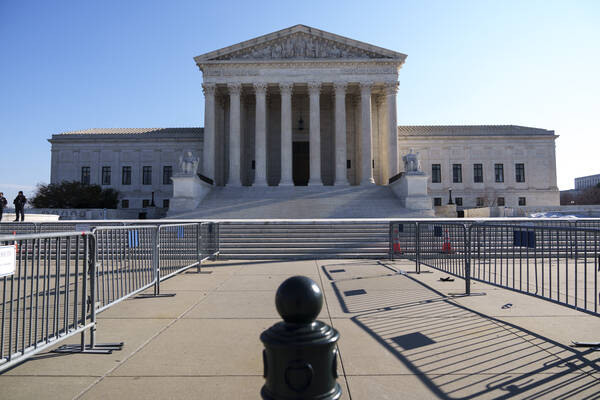 (Drew Angerer/Getty Images) There are no more open-minded conservatives on the court. The consequences of their inevitable ruling will be devastating. By Paul Butler ● Read more » | | | | What about candidate Reagan saying "it is time for a woman" before nominating Sandra Day O'Connor? By Ruth Marcus ● Read more » | | | | Although every Supreme Court appointment is consequential, this will be the least consequential appointment in decades. By Marc A. Thiessen ● Read more » | | | It's a battle of freedom of association vs. social cohesion. By Sonny Bunch ● Read more » | | | | Not everything is working in the Russian president's favor right now. By Fareed Zakaria ● Read more » | | | | A prime minister ambushed by cake sounds like a much better news cycle. By Alexandra Petri ● Read more » | | | | Religious leaders spreading doubt about coronavirus vaccines are sabotaging a society they should be serving. By Michael Gerson ● Read more » | | | Buying masks to protect you from covid-19 can — and should — be just as easy as buying sunscreen By Susan Blumenthal and Emily Stark ● Read more » | | | | Democrats can go into the midterms talking about a fresh victory rather than lamenting bills they have been unable to push through the Senate. By Eugene Robinson ● Read more » | | | | Control of the court has not always been a recurring political controversy. By Henry Olsen ● Read more » | | | | Republican perceptions have gone off the rails, even as they continue to shape our economic debate. By Paul Waldman ● Read more » | | | |




 Email
Email