| Hey, good morning ☀️The Health 202 wants to hear from you. If you have private insurance, what's it been like trying to get free at-home tests? More details below ⬇ Today: A lab study finds omicron-blocking antibodies last four months after a Pfizer-BioNtech booster, and aging services providers request emergency relief. But first: | Doctors and hospitals aren't getting all the coronavirus drugs they need | 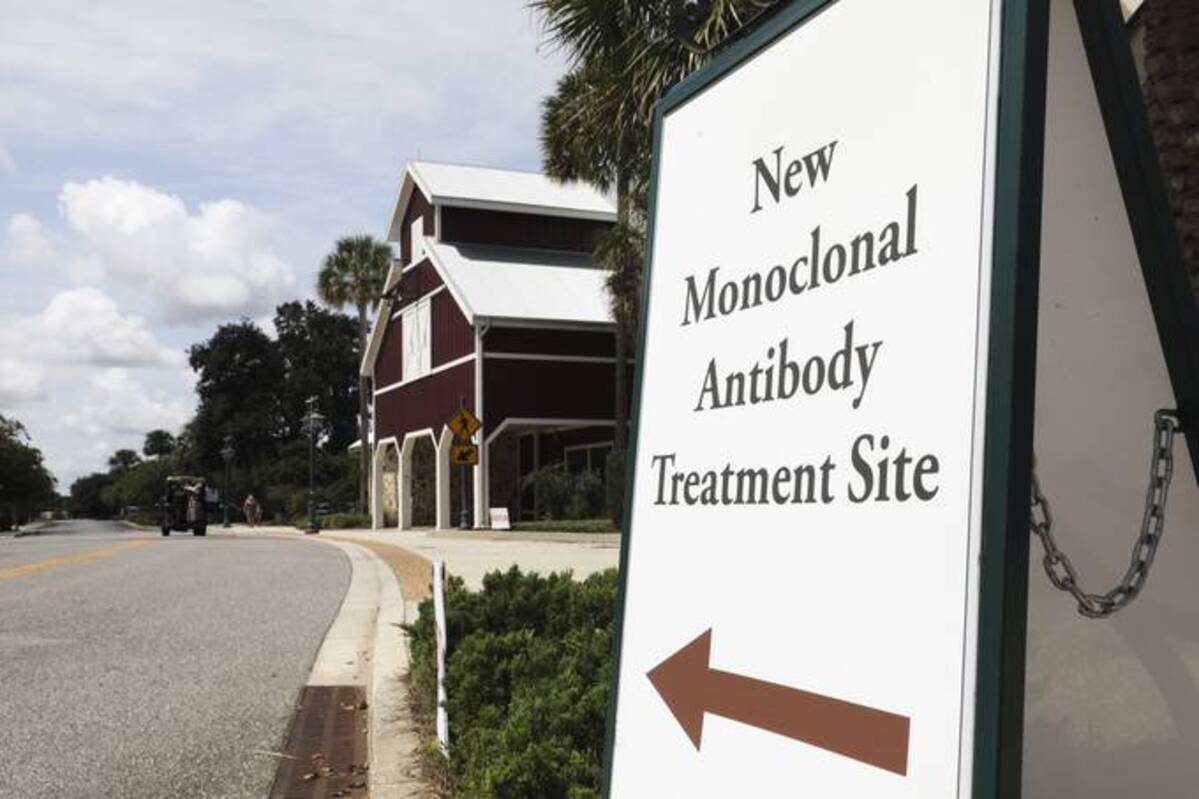 The Barnstorm Theater in The Villages, Florida has been converted into a monoclonal antibody treatment center. (Photo by Eve Edelheit for The Washington Post) | | | Key treatments to fight against omicron are in short supply. That's leaving some doctors and hospitals without enough of a critical tool intended to help patients stave off severe disease and alleviate stress on overwhelmed hospitals, according to over a half dozen state officials and major provider groups. The country now has a wider array of medicines to treat the coronavirus — even easy-to-take pills — but the demand for the limited treatments has led some state health departments and providers to instead prioritize which areas and patients get the drugs. The Biden administration is overseeing the shipment of treatments to states, but demand outstrips supply. | - "For a provider, it's almost just like a theoretical consideration because for most of the patients they're seeing … the overwhelming majority of them are never going to get this product," Scott Harris, the state health officer for Alabama's Public Health Department, said of an omicron-fighting monoclonal antibody therapy.
| | The Post's Laurie McGinley: | 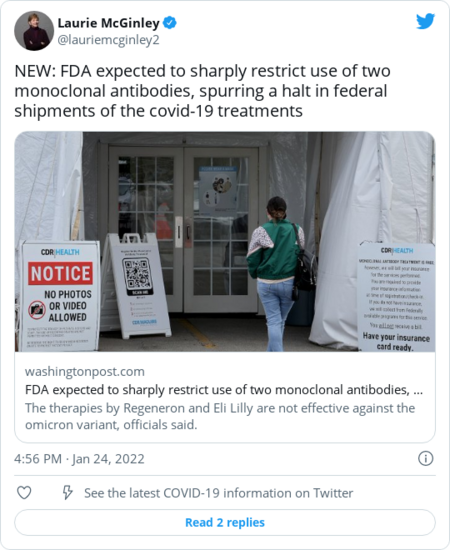 | | | | | The country has three monoclonal antibody therapies to treat the coronavirus. But two of the treatments are highly unlikely to be effective against the omicron variant, which is now responsible for more than 99 percent of coronavirus cases. | | There was some news on that front yesterday. | - The Food and Drug Administration took those two therapies off the list of covid-19 treatments for now, our colleague Laurie McGinley reports.
- The federal government is halting distribution of the two antibody medications to states, per an email sent to states and obtained by Laurie.
- That leaves just the one, sotrovimab. The Biden administration is trying to ramp up its supply, recently purchasing an additional 600,000 doses to be delivered by the end of March.
| | This week: The federal government will ship a total of 52,260 doses of sotrovimab to states, roughly on par with the amount delivered the past four weeks. The federal government's allocation to states is based on a formula taking into account case counts and hospitalization rates. In West Virginia, the state's weekly allocation of more than 250 doses of the treatment is "usually gone within the first several days of the week," said Clay Marsh, the state's coronavirus czar. And in Alabama, the state received 558 doses of the therapy last week. But roughly 8,000 requests for the treatment poured in from providers, according to Harris. The state has tried to alternate where the doses go so it can be distributed as equitably as possible in both rural and urban areas. What that translates to on the provider level: | - "I see people being careful about it. They're only giving it to [patients] who are really at high risk and elderly and unvaccinated or cancer patients," said Janis Orlowski, the chief health-care officer for the Association of American Medical Colleges.
| | In late December, the FDA authorized the first antiviral pills: one from Pfizer and another from Merck and its partner Ridgeback Biotherapeutics. Experts lauded the medicines as potential game-changers as doctors have long sought easy-to-take medications. | | Both Marsh and Harris said there hasn't been as much soaring demand for the pill from Merck due to its modest efficacy. The asks for the more effective Pfizer pill, known as Paxlovid, have been high, though supply is more limited. The administration is splitting the pills up among states according to their population. Shipments are biweekly, and states will get nearly 100,000 courses of Paxlovid over the next two-week period and four times that amount for Merck's drug. | - The shortage of the antiviral pills is "universal," said George M. Abraham, the president of the American College of Physicians.
- For instance: Sterling Ransone — the president of the American Academy of Family Physicians — said he hasn't had any patients yet on Paxlovid in his Deltaville, Va., practice.
- The Biden administration has doubled its order to 20 million courses this year, which will be distributed as the drug is manufactured.
| | Meanwhile, one treatment received a boost Friday. Federal regulators approved the use of the antiviral drug remdesivir for coronavirus outpatients at high risk of hospitalization. Doctors hope that'll make it easier for patients to get the treatment, which was originally limited to patients in the hospital. | | |  | Readers help us | | | Private insurers are now required to cover coronavirus tests. We want to hear from you how it's going. Has the process been easy or cumbersome? Have you had to pay up front for the tests or did you get them free without paying first? How long is it taking to get reimbursed? Tell us all at rachel.roubein@washpost.com. | | |  | Coronavirus | | | A bit of good news: Antibodies blocking the omicron variant persist four months after a third shot of the Pfizer-BioNTech coronavirus vaccine, according to a new study. The study provides a first glimpse of the durability of the vaccine protection, our colleague Carolyn Y. Johnson reports. And it appears to suggest a fourth shot may not be needed right now, as Americans wonder if and when they'd need another booster. | - "This is very, very new for the field," Pei-Yong Shi, a microbiologist at the University of Texas Medical Branch in Galveston, told Carolyn. His team tested antibodies in the blood of vaccinated people against an omicron-like virus in collaboration with Pfizer scientists.
| | The caveats: The study was published on a preprint server Saturday and hasn't yet been peer-reviewed. It'll need to be replicated — and for a longer period of time. | | |  | Industry Rx | | | First in The Health 202: Major aging services providers call for emergency relief. LeadingAge — which represents nonprofit providers of aging services — is calling on President Biden to work with Congress on a six-point relief package for the industry. In a letter to Biden sent Friday, the organization outlined its requests, which include a permanent program to increase workers' pay by $5 per hour; a one-time relief payment of $2,000 to millions of direct care workers; $8 billion to $10 billion in additional provider relief funds and more. | - "The Omicron surge is compounding existing challenges driven by the pandemic," Katie Smith Sloan, president and CEO of LeadingAge said in a statement, pointing to staffing shortage and operating costs.
| | |  | In other health news | | - The emergency phase of the pandemic could end this year if 70 percent of every country's population is vaccinated. But globally, conditions are still "ideal" for new variants, Tedros Adhanom Ghebreyesus, the director general of the World Health Organization, said.
- White House press secretary Jen Psaki said anti-vaccine activists are part of a "loud" and "still dangerous" minority, comments which came a day after thousands protested vaccine mandates, our colleague Amy Wang writes.
- The Supreme Court declined to hear House Minority Leader Kevin McCarthy's challenge to the chamber's proxy voting rules, Mariana Alfaro reports.
- Inside the Washington, D.C.-region's varied approach to masks in schools: Virginia's new GOP governor barred school systems from requiring face coverings. Meanwhile, systems in Maryland, D.C., and Virginia are handing out more protective KN95s for the first time, The Post's Donna St. George, Hannah Natanson and Nicole Asbury report.
| | |  | State scan | | | Mask wars: In New York, a state Supreme Court judge struck down New York's mask mandate just a week before it was due to expire, ruling the state legislature needed to sign off on the move, Amy Cheng reports. Gov. Kathy Hochul, a Democrat, said she intended to fight back. On the move? In Rhode Island, outgoing health department director Nicole Alexander-Scott is discussing whether to run for the Democratic primary for a seat in Congress, sources tell WPRI television station's Ted Nesi and Anita Baffoni. Wind down: In Montana, state health officials said they'd phase out the requirement for some Medicaid beneficiaries to pay premiums after the Biden administration said it would require the state to do so. | | Joan Alker, executive director and co-founder of Georgetown's Center for Children and Families | 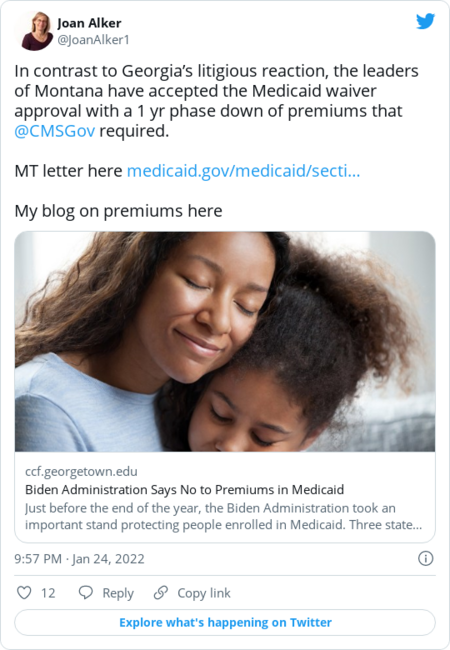 | | | | | |  | Sugar rush | | | Thanks for reading! See y'all tomorrow. | |


