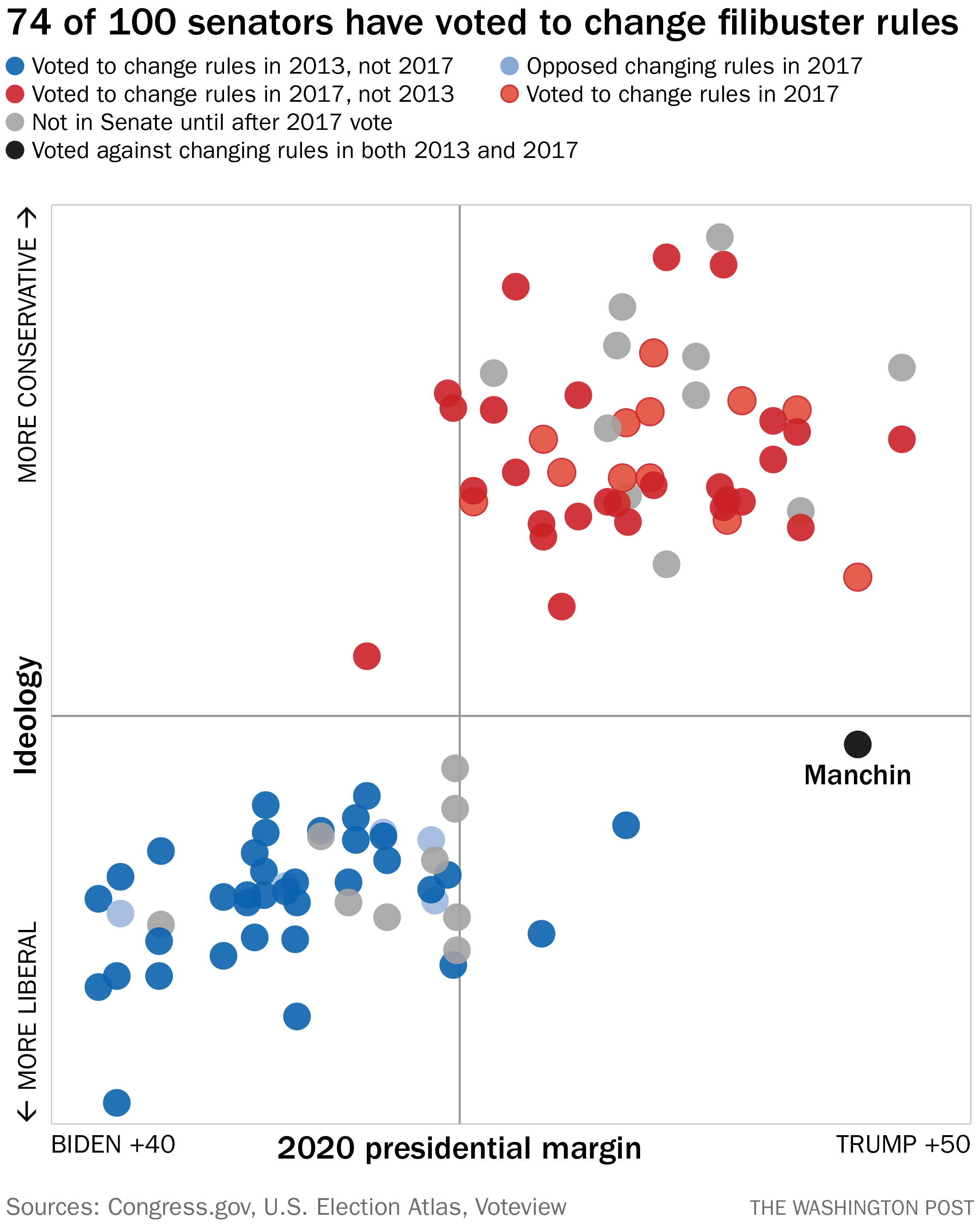
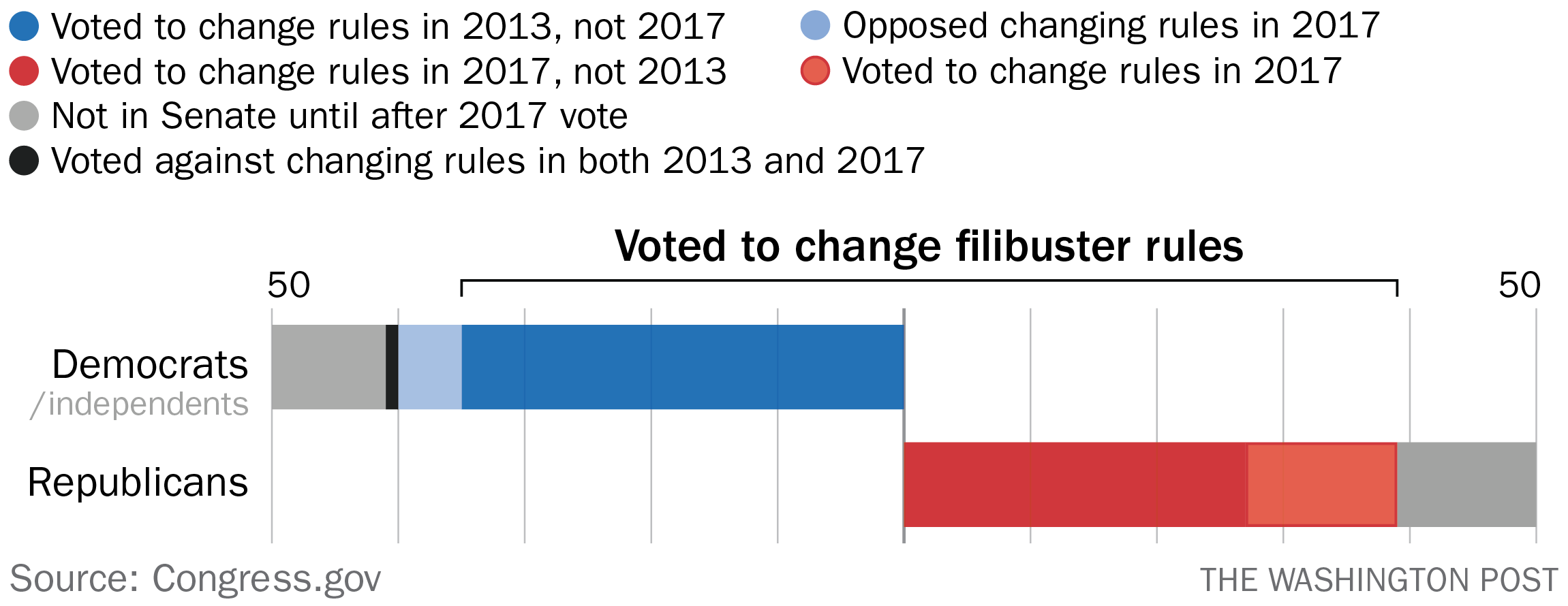
| Did a member of Congress forward this to you? Sign up here. The filibuster is a funny thing. It is often presented as this innovative device inextricably woven into the fabric of the U.S. Senate to uphold the ideals of the Founding Fathers. It is, in fact, an emergent tactic that has in the past been worked around in scores of contexts. In her book "Exceptions to the Rule," Molly Reynolds writes that "[s]ince 1969, Congress has created at least 161 separate special procedures that prevent a filibuster on specified measures." A useful bit of context for considering debates over its inviolateness. That may not be a word. Whatever. What this means is that a lot of the recent debate over whether to set the filibuster standard aside is occurring among people who, in other contexts, have already agreed to make one of those 161 exceptions. Earlier this month, I looked at two examples that seemed pretty on-the-nose as points of comparison to the Democratic push to pass a federal law that would expand access to voting: 2013 and 2017 decisions to ban the filibuster for consideration of presidential nominees. That is, they voted to override the filibuster to increase their own ability to vote. As it turns out, nearly three-quarters of serving senators voted to change the rules on one of those two occasions. Here's one way I presented that data, overlaying admittedly more data than was necessary. I chose to present this as a scatterplot in large part because I think it's more visually interesting. There are a lot of dynamics that emerge when you display the Senate as a comparison of state presidential vote (left to right) versus ideology (top to bottom, using data from Voteview). You see Sen. Joe Manchin (D-W.Va.) there for example, hanging out by himself in Deepredandmoderateland. That may not be a word either. The point: All of those dark blue dots are currently serving senators who chose to override filibuster rules to allow for a majority vote on Barack Obama's nominees in 2013 but opposed a change when Republicans wanted a majority vote on Donald Trump's Supreme Court nominees in 2017. The dark red dots are senators who held the opposite position (that is, the Republican position) both times. Gray dots mark senators elected after the 2017 vote. That there are so few is a reminder of how infrequent turnover is in the U.S. Senate. You will also notice that Manchin's circle is black. He is the only senator who opposed both changes. (Sen. Kyrsten Sinema (D-Ariz.) was not in the Senate for either vote.) Is this an overcomplicated way to show this data? Sure! I'm not vain. I can handle complaints. So in that same article, I offered another way of looking at the same thing. Same key and same color scheme, but organized in a way to show the large chunk of the Senate that had previously voted to change how the filibuster could be applied. When you have the space and the time to do so, there's no harm in offering different presentations of data. This, of course, is called datamultishowaphilia, a word that is, in fact, a word. | 


 Email
Email