| Did a friend forward this to you? Sign up here. A new New Year's tradition for me I had never wanted to make my own noodles until I saw a photograph, by Rick Poon, in Sonoko Sakai's "Japanese Home Cooking." In it, Sakai is holding a bundle of freshly cut soba noodles over a board dusted with flour. The strands are tidy and even; the bunch, thick and weighty as a horse's tail. Sakai's grasp is gentle but confident and careful, as though she's holding a kitten. "When you start putting your hands in flour, your sense of time and space changes. You slow down," Sakai writes on the page opposite the photograph. "The moment you begin mixing flour and water to make dough, you are at the beck and call of the dough. You begin a dialogue with the flour and water, and all the elements that seem to make up the universe will influence the completed dish — the quality of the ingredients, your skill, the temperature and humidity in the air, the volume, and how you feel. I am always seeking to work in harmony with these five elements." Soba, made from buckwheat, or a combination of wheat and buckwheat, is a New Year's tradition for the Japanese, who "slurp soba noodles on New Year's Eve for a long and lean life," Sakai writes. In Japanese, there's a truer-to-life onomatopoeia for "slurp": Tsurutsuru describes both the sound and action of sucking in air as you eat and swallow. For the Japanese, slurping soba, both the sound and the action, is not only intentional but a crucial part of the physiological enjoyment of eating foods such as soba, Dylan Ho explained in a 2019 essay for Taste. "Like any other human being, the Japanese enjoy the gustatory reactions to anything sweet, sour, salty, bitter, and savory (umami). In Western culture, eating is heavily defined by the experience of taste and texture. But for the Japanese, eating goes beyond just the gustatory sensations in the mouth and includes also the olfactory and post-mastication sensations of food gliding down the throat, through the esophagus, and finally settling in the belly," Ho wrote, particularly of long strands of noodles that, when swallowed almost whole, will nest comfortably, even auspiciously in the stomach. The word for this ideal sensation of satiation is nodogoshi, "an extrasensory feeling that is triggered by taste, aroma, and touch simultaneously during food or drink consumption." I've been seeking out good luck charms and solitary sensory experiences these past few weeks, so I made fresh soba for New Year's Eve this past weekend. But there's no need to make the noodles from scratch if what you're looking for right now is an easy meal. Packaged soba is easily found in most well-stocked markets. Dried soba tends to be white, pale-green or grey-brown in color, with a flavor that ranges from hay-like to deeply nutty. Pick some up for this recipe for Spicy Pork With Vegetables and Soba Noodles, a streamlined dinner with a pleasantly perky sauce. It's easily made ahead and is highly adaptable, too.  | Today's recipe | 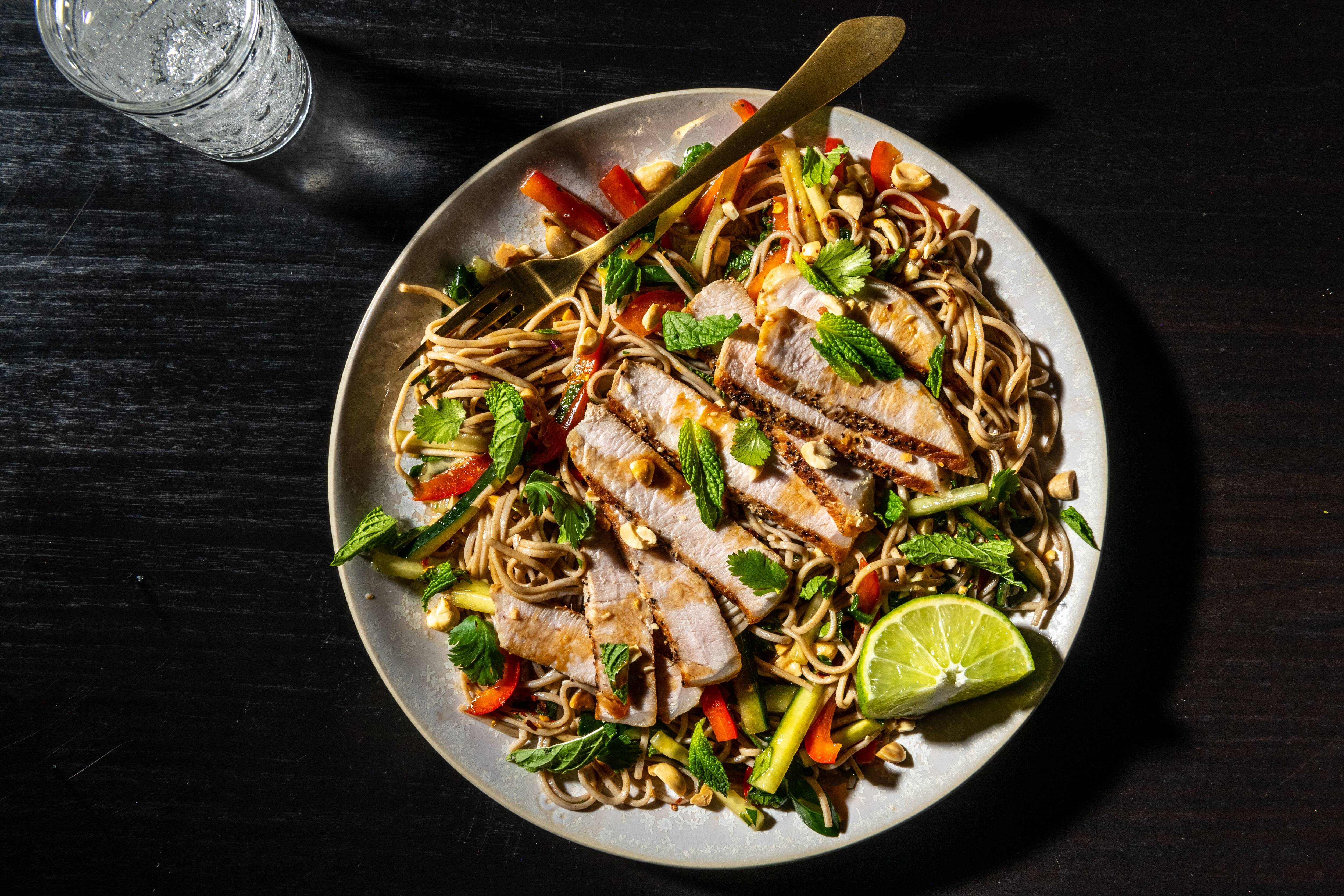 Photos by Laura Chase de Formigny for The Washington Post; food styling by Lisa Cherkasky for The Washington Post | Spicy Pork With Vegetables and Soba NoodlesRecipes editor Ann Maloney brought this dish to The Post earlier this year, and offered lots of ways to tweak it. Here are a few more: - Want to make this vegetarian? >> Skip the pork. Substitute with tofu, or more vegetables, if you'd like.
- No sweet chili sauce? >> Use equal parts hot sauce and honey or maple syrup.
- The fish sauce adds depth here >> but you could skip it and use more soy sauce if you're out.
- If you're allergic to peanuts >> Use cashews, sesame seeds or pepitas instead.
Make Ahead: Each element of this dish can be made in advance and refrigerated: The dressing can be refrigerated for up to 1 week. The chops, for up to 2 days. The noodles can be cooked, refreshed with cold water and tossed with a bit of neutral oil, and then refrigerated for up to 2 days. Storage Notes: The leftovers can be refrigerated for up to 3 days. If you do not plan to eat this all at once, you can store the pork separately and reheat it before serving it over the cold noodles. Where to Buy: Sweet chili sauce and fish sauce can be found in well-stocked supermarkets or Asian markets. Want to save this recipe? View it on Voraciously here and click the bookmark icon below the serving size at the top of the page to add it to your Reading List. For easy printing and scaling, view this recipe in our Recipe Finder. Servings: 4 to 6
Total time: 30 mins IngredientsFor the dressing - 1/4 cup sweet chili sauce, such as Ka-Me brand
- 3 tablespoons fresh lime juice (from 1 lime)
- 2 1/2 tablespoons low-sodium soy sauce, plus more as needed
- 1 1/2 tablespoons fish sauce, plus more as needed
- 1/4 teaspoon crushed red pepper flakes (optional)
For the pork and noodles - 9 ounces soba noodles (see NOTES)
- 4 boneless pork chops (about 5 to 6 ounces each) (see NOTES)
- Finely ground black pepper
- 1 tablespoon neutral oil, such as canola
- 4 scallions, sliced
- 1/2 cucumber (about 7 ounces), cut into matchsticks or bite-size pieces
- 1 red, yellow or orange bell pepper (about 4 ounces), cut into matchsticks or bite-size pieces
- 1/4 cup coarsely chopped fresh cilantro leaves, plus whole leaves for serving
- 1/4 cup coarsely chopped fresh mint leaves, plus whole leaves for serving
- 1/2 cup (about 2 1/2 ounces) salted peanuts, roughly chopped
- 1 lime, quartered
Steps1. Make the dressing: In a small bowl, whisk together the chili sauce, lime, soy sauce, fish sauce and crushed red pepper, if using. Taste, and season with a little more soy or fish sauce, if needed. 2. Make the pork and noodles: Bring a large pot of water to a boil and cook the soba noodles according to the package instructions; do not overcook. Drain and rinse thoroughly under cold running water to stop the cooking. Thoroughly drain again. Transfer the noodles to a large serving bowl and toss with half of the dressing. 3. Pat the pork dry and generously sprinkle both sides with pepper. In a large, nonstick skillet over high heat, add the oil and heat until shimmering. Add the pork chops, cooking until golden brown on both sides, about 2 to 3 minutes per side depending on thickness. (For thicker chops, test the interior temperature to ensure it is at least 145 degrees.) Transfer the pork to a plate, spoon over a little of the remaining dressing over, cover with another plate or foil and let rest for 5 minutes. 4. Add the scallions, cucumber, bell pepper and the chopped cilantro and mint to the noodles and toss with the remaining dressing to combine. 5. Thinly slice the pork against the grain and arrange the meat on top of the noodles. Drizzle any juices or dressing from the plate onto the dish, as well. 6. Scatter the peanuts and a few cilantro and mint leaves on top, tuck the lime wedges onto the side of the dish, and serve family-style. NOTES: Remove the pork chops from the refrigerator 20 to 30 minutes before cooking to take the chill off the meat. This will allow them to cook more quickly and evenly. If you don't have soba noodles, try another thin noodle, such as 7 ounces of instant vermicelli rice noodles or 1 pound of angel hair pasta. Adapted from "The Shortcut Cook" by Rosie Reynolds (Hardie Grant, 2021). Tested by Ann Maloney. Nutrition information per serving (1 1/2 cups noodles each): Calories: 391; Total Fat: 12 g; Saturated Fat: 2 g; Cholesterol: 62 mg; Sodium: 1,205 mg; Carbohydrates: 43 g; Dietary Fiber: 2 g; Sugar: 7 g; Protein: 31 g.  | Dessert | 🎧 "Dani California" by Red Hot Chili Peppers.
📖 "Why Lil Nas X's 'Dead Right Now' is the song of the year" by Damon Young in the Undefeated.
📚 "Flavors of the Sun: The Sahadi's Guide to Understanding, Buying, and Using Middle Eastern Ingredients" by Christine Sahadi Whela.
👀 Frosting.
🗣 If you liked this newsletter, please forward it to a friend! |



 Email
Email 


