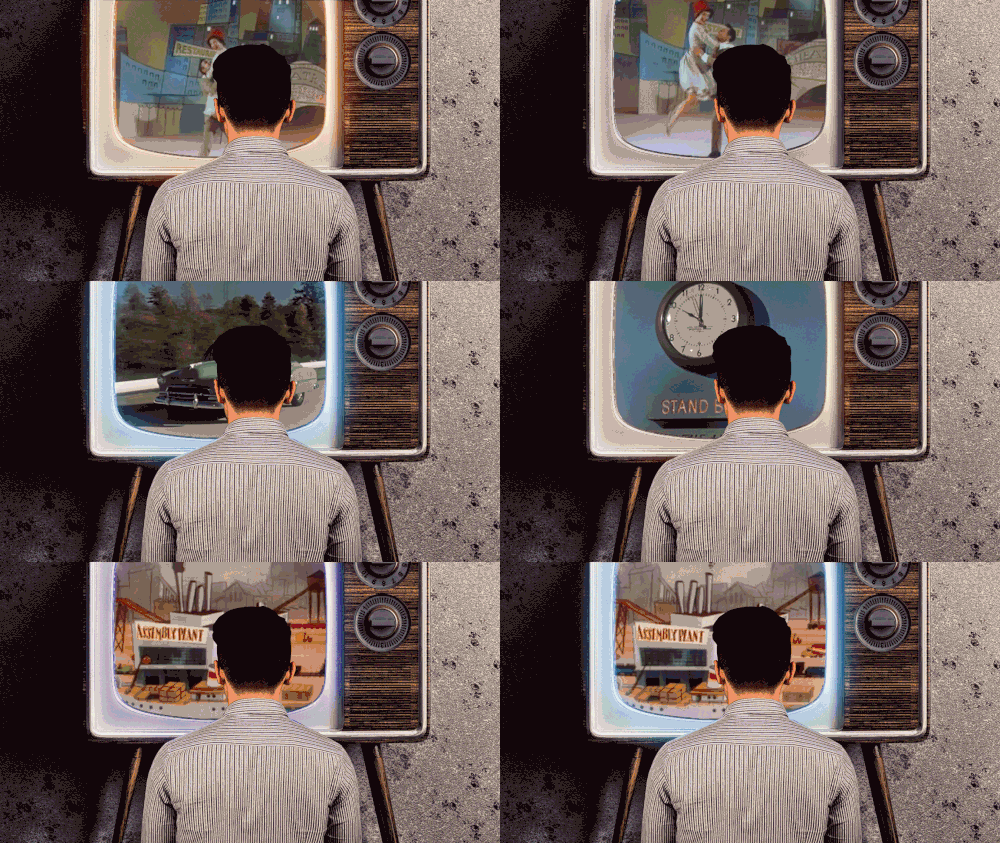
| It's finally time to unwind in front of the TV. First, you need to pick a streaming service, so you scroll. Then you need to find a show, so you scroll some more. Half an hour later, annoyed, you re-watch "The Office" for the fifth time. This is the so-called Golden Age of TV, and it's exasperating. Welcome to Day 4 of A Better Week. As streaming services proliferated over the past decade, keeping up with the countless award-winning TV shows became an exhausting, endless challenge. In 2019, Netflix alone released more original series than the entire U.S. TV industry released in 2005. There's more to watch and we're spending far too much time picking our programs. On average, U.S. adults age 18 to 34 spend nearly 10 minutes deciding what to watch, according to Nielsen. As someone who sometimes spends more time choosing a show than actually watching it, that number seems low to me. I wanted to find a better way to navigate this bottomless well of entertainment and make sure I'm getting the most possible joy out of my TV time, so I spoke to someone who did it for a living. Hank Stuever was The Post's TV critic for more than a decade, and during his time in the role, he spent 20 to 30 hours watching shows before he wrote a word. "People do have a sense of FOMO about television," Stuever said. "It's that paralysis of choice."  (Jennifer Tapias Derch for The Post) | In the past few years, I have tried to watch most of what would be considered the quintessential shows from the past few decades — the familiar titles that populate "best of" lists, such as "The Sopranos," "Breaking Bad" and "The Wire." Those shows alone required a combined 208 hours of screen time. Dedicating that many hours to a series is a massive commitment, but it's still a relatively safe investment with iconic shows. But judging whether a new release is worth it can be trickier. Stuever partially attributes this choice paralysis to this actually not being a Golden Age of TV, but rather a "Silver Age," one that he believes is defined by "quantity over quality." Stuever suggested taking a low commitment approach to trying new shows: Keep a running list of shows that pique your interest, whether it's from reviews or recommendations from friends. This can be a shared Google doc with a few friends, which also makes it a more social activity. Start by watching the first 10 minutes, or if you have the time, the whole first episode, without committing to the entire first season. If you don't like it, give yourself the out. We've all had the friend who urges you to "just get through the first season." Ignore that advice. Find a critic that you like, like The Post's new TV critic, Inkoo Kang. "If [a show is] not doing it for you, I don't care what any critic or any of your friends say – it's not your show," Stuever said. My girlfriend and I tried his advice on a recent work night after re-watching an episode of "Parks and Recreation" for the hundredth time. We spent a few minutes putting together a list of shows we had been meaning to watch. We wanted a mix of shows we kept seeing on "best of" lists and newer shows our friends keep bringing up at happy hour. We settled on five — "The Crown," "Pose," "The West Wing," "Watchmen" and "The Good Wife." We decided to watch the first episode of each show over the course of a week to decide which series we would take on next. Your turn: Make a list of three to five shows (or documentaries and films) that you've been meaning to watch. Then try out the first 10 minutes next time you're watching TV. By committing an hour at most to each show, it immediately lowered the stakes. It felt more like window shopping. To my surprise, we eventually settled on "The Crown." We probably saved about an hour of browsing time in the past week alone. Applying this low-commitment approach to new shows and allowing myself to bail whenever I find myself losing interest has made TV watching feel like a more intentional decision. If part of the reason you want to watch TV is to unplug, I strongly recommend putting your phone out of reach or watching a show with subtitles, which might make it easier to focus. People watch shows for different reasons. There are some ubiquitous programs – such as "Game of Thrones" — that dominate pop culture coverage and wind up infiltrating your social circles. If all you want is to be able to keep up with the conversation, you could just read a few Wikipedia recaps. Or watch the shows in fast forward — but you didn't hear that from me. Coming tomorrow: Finding the time for friends | 



 Email
Email